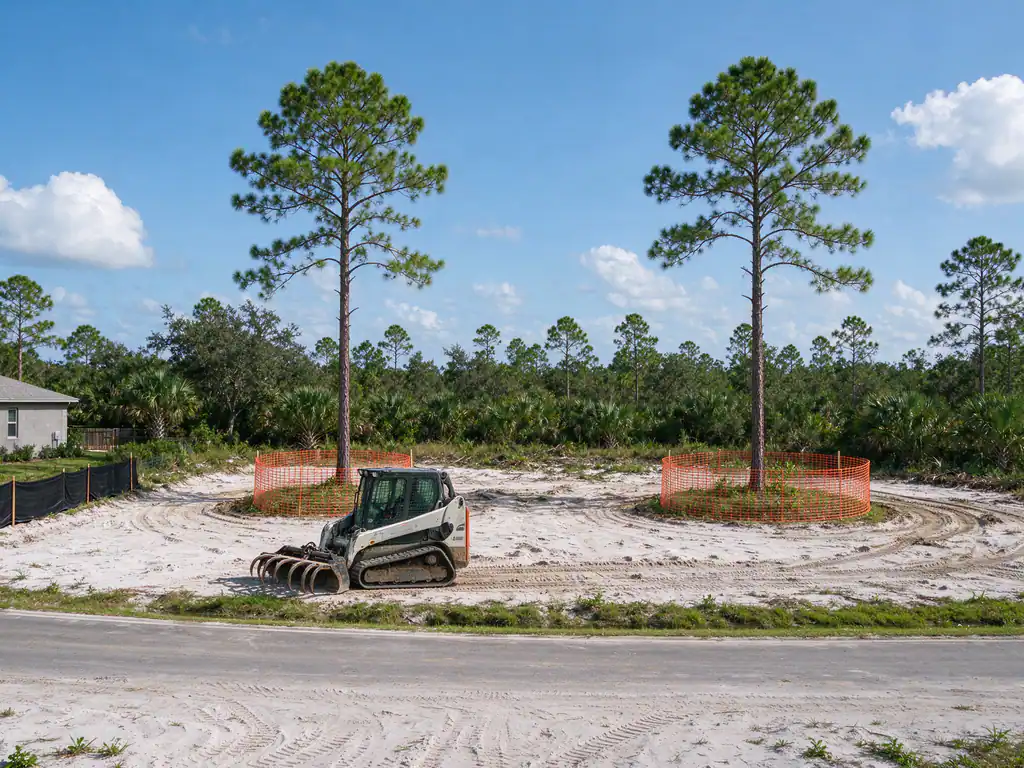
Plate III.1 · Residential platted lot
Lot clearing
A platted lot opened to the site plan: trees and palmetto out where the house, driveway and septic go, marked keepers protected, and stumps handled to the finish the builder needs.

Plate I
In Palm Bay, any clearing on a residential lot under an acre needs the city's tree removal and land clearing permit, and for a new house the building permit must already be under review. What grows on the lot decides the rest of the scope.
Legend Numbers that set a clearing job in Palm Bay
Plate II · Key to the lot
Read down the key until a line matches the lot. Each one points to the service that answers it.
Palm Bay has 22,155 vacant platted single-family lots, averaging 0.27 acre. Clearing one for a house needs a building permit already under review, and its application number goes on the clearing request, so the clearing is scoped against the house plan rather than scraped to sand.
see Lot clearingIn May 2008 a brush fire in southwest Palm Bay ran east on the wind; 33 homes were destroyed and 236 damaged. Palm Bay Fire's advice afterward was to clear dense brush at least 30 feet from a home. Thinning the understory while keeping the pines is a brush clearing job, not a full clear.
see Brush clearingBrazilian pepper is on Florida's noxious weed list, and Palm Bay requires Class I invasives on a property being developed to be removed before the certificate of occupancy. Cut stems resprout from the stump, so the job is judged by what happens to the root crown.
see Brazilian pepper removalStumps left in a pad area rot and leave soft spots under fill, while stumps in a future lawn only need grinding below grade. Which stumps get pulled and which get ground depends on what will be built over each one.
see Stump grindingPlate III · All services
Each service below is a different finish. The first four cover the broadest jobs; the rest cover particular plants, sites and cleanups.
Plate III.1 · Residential platted lot
A platted lot opened to the site plan: trees and palmetto out where the house, driveway and septic go, marked keepers protected, and stumps handled to the finish the builder needs.
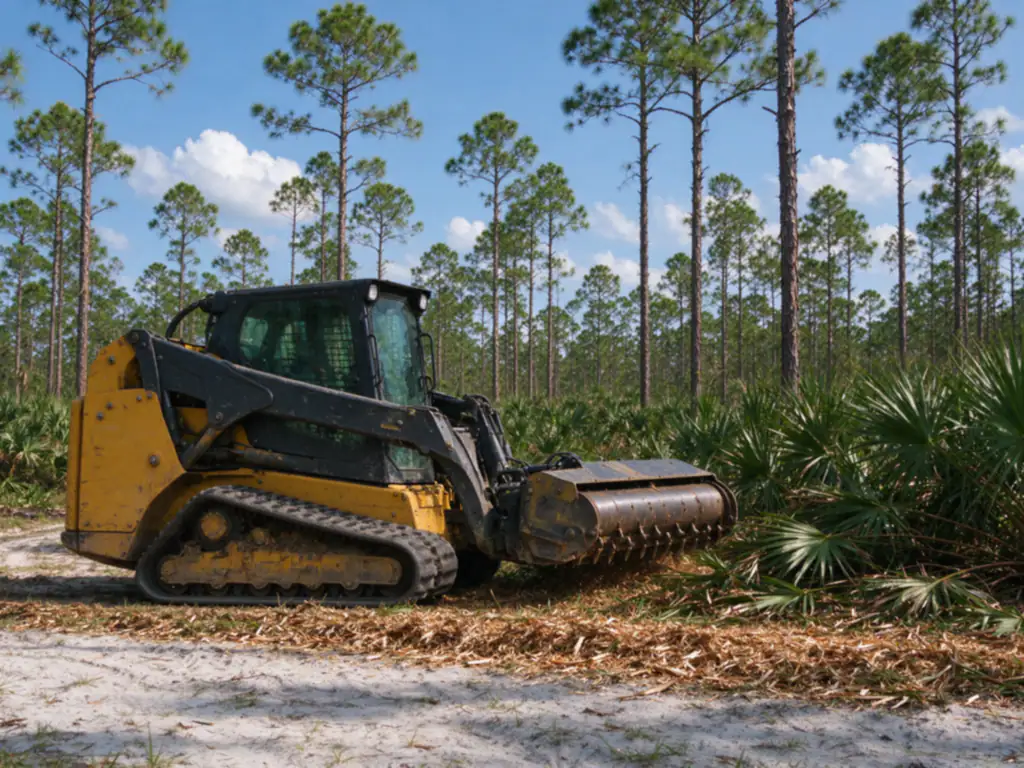
Plate III.2 · Method: mulching head
Brush, palmetto and small trees shredded where they stand into a mulch layer. Roots and stumps stay in the ground, so it opens land without turning it into a building pad.
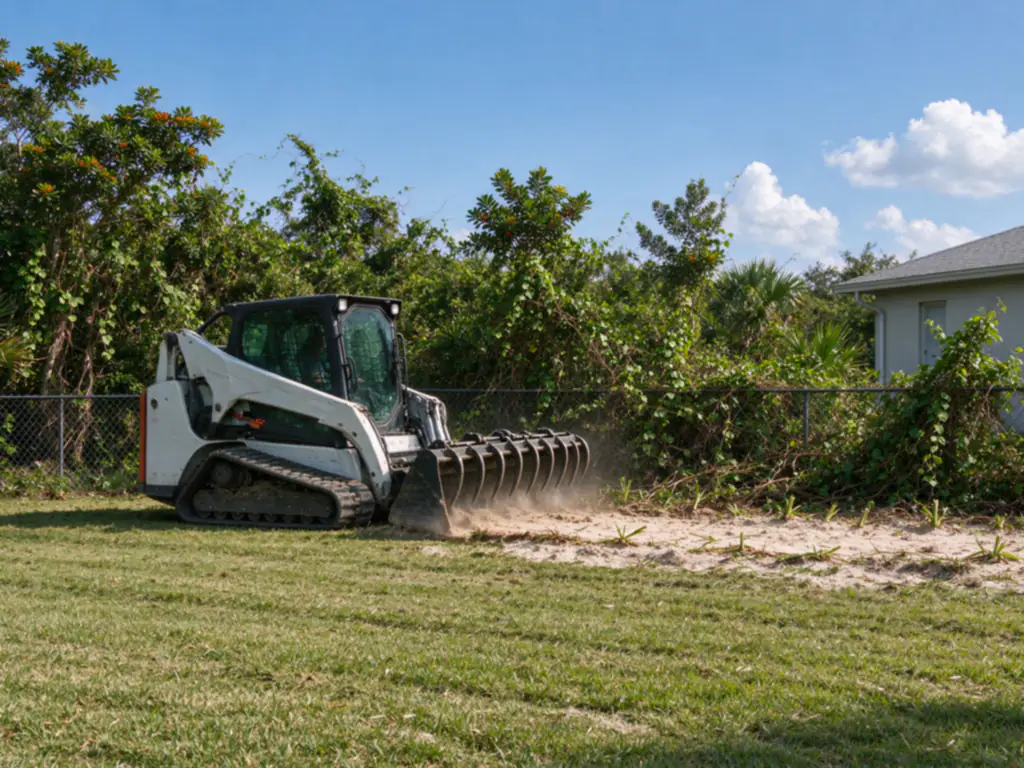
Plate III.3 · Understory and vines
Underbrush, vines and saplings cut or mulched to ground level, under the trees you keep, with a straight answer about what grows back and how fast.
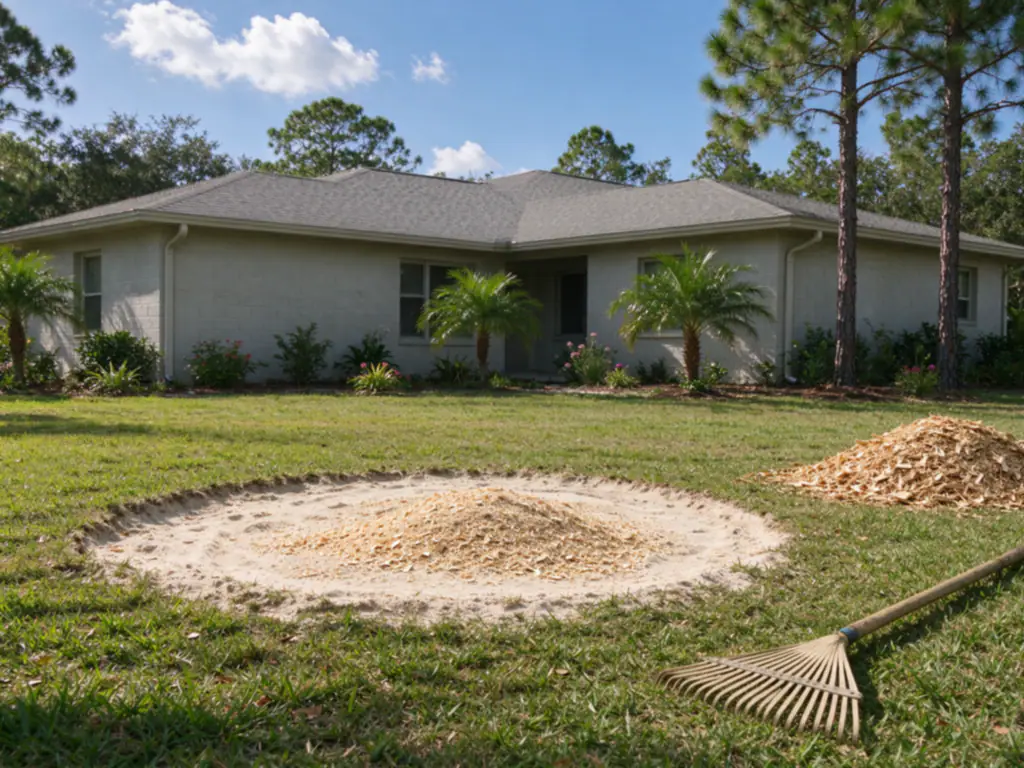
Plate III.4 · Below-grade grind
Stumps ground below grade where lawn, driveway or path will go. The grindings refill the hole or are hauled away, and the roots past the grind decay slowly in the sand.
Plate III.5 · Roots and buried organics
Clearing takes what is above ground. Grubbing pulls the stumps, roots and buried organic layer out of the building area so fill and a slab sit on clean sand.
Plate III.6 · Pinus elliottii, Sabal palmetto
Unwanted growth out and the keepers flagged and fenced at the root zone the city sizes from trunk diameter, so the trees you save still count on the landscape plan.
Plate III.7 · Serenoa repens
Palmetto trunks creep along and just under the sand. Mowing knocks the fronds down but leaves those trunks to resprout, so a house or lawn area needs the root mass grubbed out.
Plate III.8 · Schinus terebinthifolia
Cut pepper resprouts from the stump, so removal means getting the root crown out. On a new Palm Bay home site it has to be gone before the certificate of occupancy.
Plate III.9 · Years of regrowth
A vacant lot left for years, with brush, vines and dumped debris, cut back to ground that can be mowed, surveyed, sold or built on.
Plate III.10 · Logs, slash and stumps
Clearing debris chipped and spread, mulched in place, or loaded and hauled to a permitted site. Which one fits depends on the finish and on whether burning is allowed at all.
Plate III.11 · Grazing land
Palmetto and invasive brush knocked back on grazing land so grass can recover, with fence lines opened for repair. Whether grazing land needs a clearing permit depends on the town or county.
Plate III.12 · Site plan and site work permit
Clearing to an approved site plan, with the site work permit, tree survey and erosion controls in place first. Disturbing an acre or more also needs state stormwater permit coverage.
Plate III.13 · Windthrown pine and limbs
Downed pines and limbs cut up and cleared from yards and lots. Palm Bay’s code lets an imminent hazard come down on a verbal approval, and declared emergencies are an exception to the permit.
Plate IV · Method
A new home lot under an acre needs four trees and ten shrubs before the certificate of occupancy. A kept tree of 6 to 12 inches DBH counts as three of those trees, and one of 20 inches or more counts as five, so marking keepers before clearing can save buying and planting replacements.
Mulching leaves roots and a mulch mat; grubbing removes them. A slab needs grubbed ground, a lawn usually does not, and a wooded buffer may need neither. Naming the finish first keeps the lot from being over-cleared or cleared twice.
Burning a land clearing pile needs Florida Forest Service authorization and 300 feet from any occupied building, and Palm Bay's fire chief has banned open burning when the drought index ran high. On a lot with neighbors, chipping or hauling is usually the realistic choice, and it is priced in from the start.
The ranges further down this page and the cost estimator give a budgeting number without a phone call. A site visit then narrows it to this lot's density, stumps, access and haul distance.
Plate V · Field procedure
The address, lot size, what is planned and what should stay. Whether the building permit has been applied for is asked here, since Palm Bay's clearing permit depends on it.
The lot is walked to mark keepers, note species and trunk diameters, look for gopher tortoise burrows and wet ground, and check access from the street. The scope names the method, the stump plan and where the debris goes.
With permits in hand, root zone barricades go up around kept trees first. Then the vegetation comes down, the building area is grubbed where the finish calls for it, and debris is chipped, mulched or loaded out.
The finished lot is walked against the scope. Anything still ahead, such as fill, grading, erosion control or replacement planting, is named so the next trade starts on time.
Send the address and what grows on it
A lot number, a rough idea of what is planned and a few phone photos are enough to start a scope.
Plate VI · Budgeting
These are national budgeting ranges for the three most requested services, shown so you can plan before anyone visits. They are not quotes. A dense Palm Bay lot with heavy palmetto root mass and many stumps can land above them.
Label VI.a
$800-$3,000
per quarter-acre lot, national budgeting range
Label VI.b
$125-$300
per machine hour with operator, national budgeting range
Label VI.c
$120-$400
per first stump, national budgeting range
Get a number for your lot with the land clearing cost estimator
Clearing more than a lot or two? Land clearing cost per acre in Florida, and what moves it.
Plate VII · Choosing a method
Three ways to open the same lot, and what each leaves behind. The right one depends on what comes next on the ground.
| Forestry mulching | Clear and grub | Selective clearing | |
|---|---|---|---|
| What comes out | Brush, palmetto and small trees, shredded where they stand | Trees, brush, stumps, roots and the buried organic layer in the work area | Only what is marked: understory, invasives and chosen trees |
| Roots and stumps | Stay in the ground | Pulled from the building area | Kept trees untouched; removed stumps ground or pulled |
| Debris | Becomes a mulch layer on site | Chipped, hauled or, where allowed, burned | Small volume, usually chipped or hauled |
| Ground left | Covered, walkable, roots holding the sand | Bare sand, ready for fill and grading | Shaded lot with open understory |
| Ready for a slab? | No; grubbing still needed under a building | Yes, once fill and compaction are done | Only where the footprint was grubbed |
| Palm Bay permit note | Mulching underbrush in place is grubbing under the code; homes under an acre and areas of a quarter acre or less are exempt from the separate grubbing permit | Lots under an acre need the tree removal and land clearing permit before work | Removing any tree of 6 in. DBH or more needs the permit; kept trees earn landscape credits |
| Tradeoff | Fast and low disturbance, but palmetto and pepper can resprout | Most complete, most hauling, and bare soil to stabilize | Slower per square foot, most protection for what stays |
Most house lots end up as a mix: grubbed where the slab, driveway and septic go, mulched or selectively cleared around the edges.
Plate VIII · Range
Vacant platted lots waiting for a house are where most residential clearing starts. The counts come from Brevard County parcel records; each area's own clearing rule is the one to check first.
Source: Brevard County Property Appraiser parcel layer, vacant platted single-family land.
| Area | County | Vacant platted lots | Average lot | Clearing rule to know |
|---|---|---|---|---|
| Palm Bay | Brevard | 22,155 | 0.27 ac | City permit for any clearing on a residential lot under 1 acre |
| Malabar | Brevard | 141 | 1.43 ac | Town land clearing and tree ordinance; 583 more unplatted parcels average 1.45 ac |
| Grant-Valkaria | Brevard | 488 | 0.93 ac | Acreage town: 2,657 more unplatted vacant parcels average 1.38 ac |
| West Melbourne | Brevard | 260 | 0.19 ac | City building permit before any clearing, even silt fence staking |
| Melbourne | Brevard | n/a | n/a | Tree removal application lists trees from 4 in. DBH |
| Viera and Suntree | Brevard | 1,624 | 0.18 ac | County rules apply in the unincorporated part of ZIP 32940 |
| Titusville | Brevard | 801 | 0.25 ac | City permit before removing a tree of 4 in. diameter or more |
| Rockledge | Brevard | 455 | 0.19 ac | Four trees must remain on the lot after any removal |
| Cocoa | Brevard | 895 | 0.22 ac | Notarized tree removal and land clearing application |
| Sebastian | Indian River | n/a | n/a | Protected trees from 4 in. DBH; exotic trees shown on the clearing survey |
Also served: Melbourne Village, Micco and Roseland. Unincorporated Brevard uses the county's Small Scale Land Clearing Permit, a $240 non-refundable fee through Brevard County Natural Resources Management.
All service areasPlate IX · Notes
Yes, if the lot is residential and under an acre. Palm Bay's Tree Removal and Small Residential Site Land Clearing Permit covers any clearing on those lots, and for new construction the building permit must already be under review, with its application number on the clearing request. The application needs the recorded deed and a sketch showing every tree's species and diameter and which ones stay.
A national budgeting range for clearing a quarter-acre lot is $800 to $3,000, before grading, fill or survey. A heavily wooded Palm Bay lot with thick palmetto, many stumps and a long haul can run higher. The cost estimator gives a number for your lot's size and density, and a site visit narrows it from there.
Any tree you mark can stay if the machines keep out of its critical root zone, which Palm Bay sizes at 12 inches of diameter for every inch of trunk. Kept trees also count toward the four trees a new home lot under an acre needs before the certificate of occupancy: a 6 to 12 inch tree counts as three.
No. Forestry mulching shreds what is above ground and leaves stumps low and roots in the sand. That holds the soil and suits buffers, trails and pasture, but a house, driveway or septic area still needs grubbing so organic material does not rot under fill.
Not usually. After clearing, the building area may still need grubbing, fill to reach the required elevation, grading, compaction and erosion control, and those are earthwork rather than clearing. A clearing scope should say exactly where it stops so the builder knows what is left.
Rarely on a house lot. Florida Forest Service rules require authorization for land clearing piles and set them at least 300 feet from any occupied building, 50 feet from brush and 100 feet from a paved road. Palm Bay's fire chief has also banned open burning during high drought readings. Chipping, mulching or hauling are the usual answers.
On a lot being developed in Palm Bay, yes. The city's code prohibits Class I invasive species and requires any on the property to be removed before a certificate of occupancy is issued. Because cut pepper resprouts from the stump, removal should include the root crown, not just the canopy.
Gopher tortoises are protected in Florida. The Florida Fish and Wildlife Conservation Commission requires a relocation permit before any work within 25 feet of a burrow. If the work can stay 25 feet away from every burrow, a permit may not be needed, which is why burrows are looked for before the scope is set.
Late winter and spring are usually the driest for the ground: in EauGallie sand the wet layer sits about 12 inches down from June to November and drops to about 4 feet by April and May. Those dry months are also when burn bans tend to be declared, and Palm Bay's federal scrub-jay permit restricts clearing during nesting season where active nests are on or near a lot.
Where the root mass stays, yes. Saw palmetto spreads by trunks that run along and just under the sand, and those resprout after mowing or mulching. Areas that need to stay clear, such as a lawn or building pad, need the trunks and roots grubbed out; edges and buffers can be mowed again as they recover.
Plate X · Estimate
Get an estimate for clearing your lot
Call, or send the lot details below. Include the address or parcel number, what you plan to build or keep, and whether the building permit has been applied for.
(321) 513-1820Outside these hours, emergency calls only.