Residential platted lot
Lot clearing
A platted lot opened to the site plan: trees and palmetto out where the house, driveway and septic go, marked keepers protected, and stumps handled to the finish the builder needs.

Range plate · Titusville, Brevard County
In Titusville, the tree permit depends on whose land it is. A house with a certificate of occupancy older than a year is exempt; a vacant or brand-new lot needs a permit for any tree of 4 inches or more, and land clearing fires are not allowed on normal jobs.
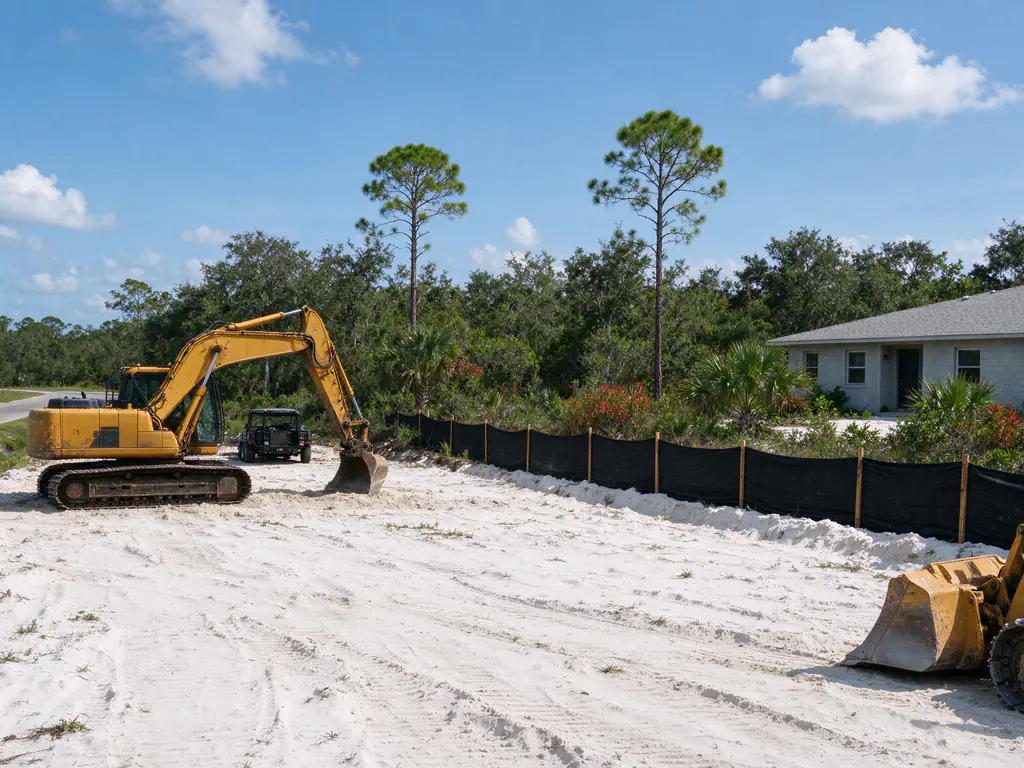 Plate. A Titusville home site, Brevard County
Legend What changes a clearing job in Titusville
Key to the parcel
Any tree of 4 inches or more needs a city permit before it comes down, with a drawing of tree locations. The plan starts from that sketch.
see Lot clearingTrees from 14 inches up are mitigated in inches of trunk, so keeping one large tree can save more than clearing around it costs.
see Selective clearingTitusville has a set of large unplatted tracts. Clearing at that scale is permitted per acre, and only large-scale jobs can ask about a special burn permit.
see Forestry mulchingFires for land clearing debris are prohibited on ordinary jobs, so the material is chipped, mulched in place or hauled.
see Debris haulingServices
Residential platted lot
A platted lot opened to the site plan: trees and palmetto out where the house, driveway and septic go, marked keepers protected, and stumps handled to the finish the builder needs.
Pinus elliottii, Sabal palmetto
Unwanted growth out and the keepers flagged and fenced at the root zone the city sizes from trunk diameter, so the trees you save still count on the landscape plan.
Logs, slash and stumps
Clearing debris chipped and spread, mulched in place, or loaded and hauled to a permitted site. Which one fits depends on the finish and on whether burning is allowed at all.
Method: mulching head
Brush, palmetto and small trees shredded where they stand into a mulch layer. Roots and stumps stay in the ground, so it opens land without turning it into a building pad.
Roots and buried organics
Clearing takes what is above ground. Grubbing pulls the stumps, roots and buried organic layer out of the building area so fill and a slab sit on clean sand.
Site plan and site work permit
Clearing to an approved site plan, with the site work permit, tree survey and erosion controls in place first. Disturbing an acre or more also needs state stormwater permit coverage.
Field procedure
The address, whether there is a house on it and since when, and what is planned. That answers the permit question before anything else.
Trees are measured and keepers marked, and the visit looks for gopher tortoise burrows, scrub, wet ground and the way in for machines and trucks.
The scope lists the trees by diameter and tier, the clearing area, the stump plan and the debris route, with the city permits the job needs.
With the permit issued, keepers are protected and the work is done; the hand-off walk goes over the site and the trees left standing.
Last Updated:
A Titusville house that has held its certificate of occupancy for more than a year can lose a tree without a city permit, while the vacant lot next door cannot lose one of 4 inches without asking first. So the first thing Flatwood Land Clearing Palm Bay settles on a Titusville lot clearing, building site or acreage job is which side of that line the property sits on; licensed and insured contractors then carry out the clearing.
Titusville’s land development code, as rewritten by Ordinance 20-2021, says no one may cut down, remove or effectively destroy a tree with a trunk of 4 inches or more, measured 4.5 feet above the ground, before a city permit. That is a lower line than Palm Bay’s 6 inches. The exemption is for the owner of an existing single-family dwelling, and existing means a year after the certificate of occupancy, so a buyer of a vacant lot or a brand-new house is inside the rule. Common areas and tracts in a subdivision are not exempt. The permit goes through Community Development’s Site Permits desk with an application and a drawing of tree locations. Dead, diseased and hazard trees have the fee waived, and trees the code classes as nuisance trees need no permit. Where the work is lot clearing for a new house, that drawing is also the start of the scope.
The code sorts native trees into three tiers: significant from 14 to under 20 inches, specimen from 20 to under 46, and heritage at 46 inches and up. A heritage tree needs Development Review Committee approval before removal. Replacement is counted in trunk inches. In residential subdivisions and projects that meet the canopy targets, the removed diameter is replaced at 50 percent for significant trees, 100 percent for specimen and 200 percent for heritage; projects that miss the targets replace specimen and heritage trees two for one and owe nothing for significant ones. When replanting is not possible, the last resort is a payment per net inch lost to the city’s Public Landscaping Trust Fund, and the code sets a lower rate when trees are logged instead of burned. So a 24-inch live oak in the middle of a building pad can carry real cost, and selective clearing that moves a driveway around it may pay for itself.
Titusville also sets canopy targets. Residential subdivisions must keep 25 percent total canopy, 15 percent of it preserved, and other development, including single-family lots outside a subdivision, can meet 20 and 10 percent to earn reduced mitigation. Undisturbed scrub oak, sand live oak and Chapman oak over 36 inches tall can count as canopy. That matters here because Brevard County’s scrub-jay map shows 12 historical survey polygons reaching into the city, covering about 3,724 acres, with 42 families counted in 1993 and 27 in 2000 to 2002. A lot with scrub on it is screened before clearing, as the scrub-jay guide explains, and the same scrub may be the cheapest canopy to keep.
Titusville’s code, amended by Ordinance 33-2021, prohibits fires for burning trash, underbrush and similar material in connection with land clearing. The fire chief can approve a special burn permit for large-scale clearing, case by case, with a fee to the fire department and a city permit carrying Florida Forest Service and fire department conditions, and burning without a permit is fined for each occurrence. So debris on an ordinary lot is planned from the start as chipping and spreading, forestry mulching in place, or loading for debris hauling. The guide to burning land clearing debris covers the state rules that sit under the city’s.
Brevard County’s parcel data shows two scales of work in Titusville. There are 801 vacant platted single-family lots averaging a quarter acre, led by Tranquility, Verona Village, Odyssey Ridge, Huntington Park, Read and Allens and Lincoln Park, next to 15,079 homes on lots of about the same size. And there are 30 vacant unplatted single-family parcels of 5 acres or more, about 1,264 acres between them, plus vacant commercial and industrial tracts. The city’s fee schedule reflects that split: land alteration and clearing permits are charged a base fee plus an amount per acre, and tree removal a base fee plus an amount per tree, per the city’s current schedule. Larger tracts heading for a site plan fit commercial land clearing, with clearing and grubbing where a pad will be built. The lot clearing cost guide explains what drives the clearing price itself, and what to do after land clearing covers the steps once the machines leave.
Method
Titusville's mitigation is counted in inches, so a survey of trunk sizes tells you which trees are cheap to remove and which ones cost more to lose than to keep.
With land clearing fires off the table for ordinary jobs, the scope chooses between mulching in place, chipping and hauling at the start, not after the pile is built.
Range
City of Titusville Community Development, Development Services (Site Permits), 555 S Washington Ave, 321-567-3775. Special burn permits go through Titusville Fire and Emergency Services.
Notes
Not if the house is an existing single-family dwelling, which Titusville's code defines as one whose certificate of occupancy is more than a year old. The owner of a vacant lot, or of a house finished within the last year, needs a city permit for any tree of 4 inches or more in diameter. Common areas in a subdivision are not exempt.
A national budgeting range for clearing a quarter-acre lot is about $800 to $3,000, before grading, fill or survey. In Titusville, debris is chipped, mulched or hauled rather than burned, and the city's permit and any tree mitigation are separate from the clearing price, so the tree survey matters to the total.
Titusville sorts native trees into significant (14 to under 20 inches), specimen (20 to under 46) and heritage (46 and up) tiers. In residential subdivisions, removed trunk diameter is replaced at 50, 100 and 200 percent by tier, and a heritage tree needs Development Review Committee approval. A payment per inch lost to the city's landscaping trust fund is the last resort.
Not on an ordinary job. Titusville's code prohibits fires for burning trash and underbrush in connection with land clearing. The fire chief can approve a special burn permit for large-scale clearing case by case, with a fee and Florida Forest Service and fire department conditions, and burning without one is fined per occurrence.
It can. Titusville's code lets undisturbed scrub oak, sand live oak and Chapman oak taller than 36 inches count as canopy. Residential subdivisions must keep 25 percent total and 15 percent preserved canopy, and other development, including single-family lots outside a subdivision, can meet 20 and 10 percent to reduce mitigation.
Neighboring range
Estimate
Get an estimate for clearing in Titusville
Send the address, whether there is a house on the lot and how long it has been there, and what you plan to build or open.
(321) 513-1820Outside these hours, emergency calls only.