Residential platted lot
Lot clearing
A platted lot opened to the site plan: trees and palmetto out where the house, driveway and septic go, marked keepers protected, and stumps handled to the finish the builder needs.

Range plate · Sebastian, Indian River County
Sebastian sits across the county line in Indian River County, under a tree code that protects trees from 4 inches and scrub oak from an inch and a quarter. A lot there is cleared from a tree survey, with a minimum number of trees left standing.
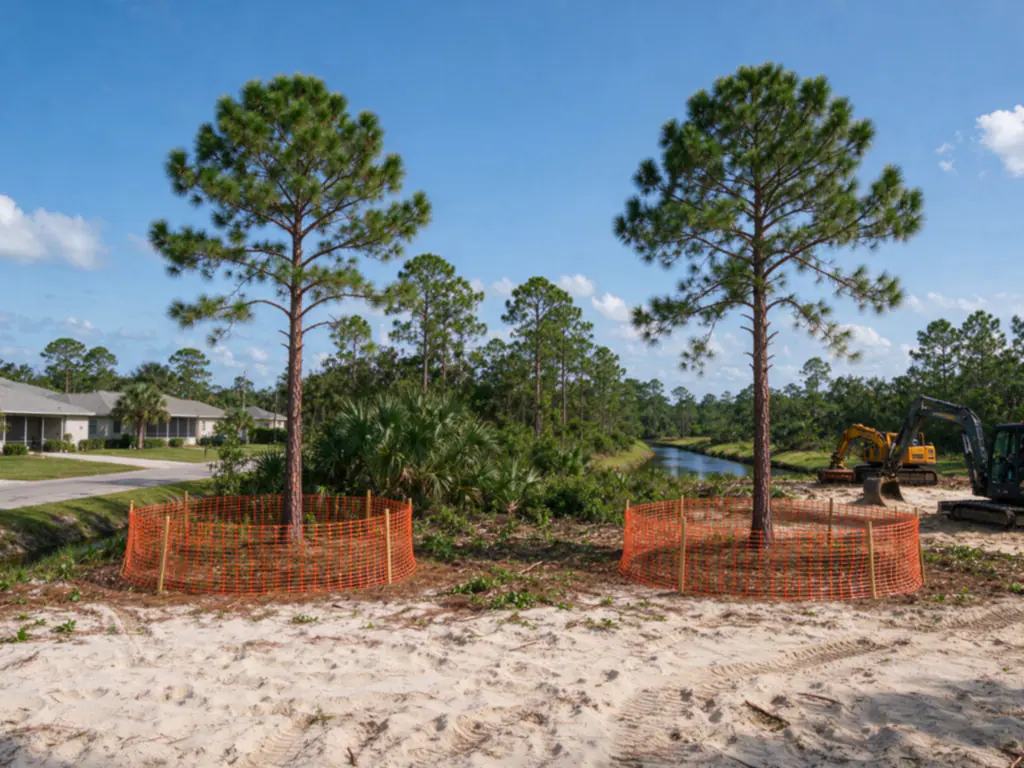 Plate. A Sebastian home site, Indian River County
Legend What changes a clearing job in Sebastian
Key to the parcel
The land clearing application needs a survey locating the protected, specimen and exotic trees and a Tree Calculation Form, so the survey is drawn before the clearing plan.
see Lot clearingAny scrub oak of an inch and a quarter at the base counts as protected. Where a lot is full of it, deciding what stays is most of the scope.
see Selective clearingProhibited exotic trees are marked separately on the survey and may not need a permit, but the city asks owners to contact it for approval first.
see Brazilian pepper removalIn unincorporated Indian River County, a lot over a quarter acre needs a tree removal permit application or exemption form with the home permit.
see Clearing and grubbingServices
Residential platted lot
A platted lot opened to the site plan: trees and palmetto out where the house, driveway and septic go, marked keepers protected, and stumps handled to the finish the builder needs.
Pinus elliottii, Sabal palmetto
Unwanted growth out and the keepers flagged and fenced at the root zone the city sizes from trunk diameter, so the trees you save still count on the landscape plan.
Schinus terebinthifolia
Cut pepper resprouts from the stump, so removal means getting the root crown out. On a new Palm Bay home site it has to be gone before the certificate of occupancy.
Roots and buried organics
Clearing takes what is above ground. Grubbing pulls the stumps, roots and buried organic layer out of the building area so fill and a slab sit on clean sand.
Below-grade grind
Stumps ground below grade where lawn, driveway or path will go. The grindings refill the hole or are hauled away, and the roots past the grind decay slowly in the sand.
Logs, slash and stumps
Clearing debris chipped and spread, mulched in place, or loaded and hauled to a permitted site. Which one fits depends on the finish and on whether burning is allowed at all.
Field procedure
The address, whether it is inside the City of Sebastian or the county, the house plan if there is one, and any tree survey already done.
Trees to keep are marked against the survey, and the visit checks for gopher tortoise burrows, wet ground and how machines reach the building area.
The scope ties each area to a method, lists the trees to remove and keep, sets barricade distances, and names the stump and debris plan.
Once the city or county permit is issued, barricades go up and the work is done, and the hand-off walk checks the trees left against the minimum.
Last Updated:
In Sebastian a scrub oak counts as a protected tree once its base is an inch and a quarter across, which tells you most of what is different about clearing a lot south of the county line. Lots and building sites in Sebastian and Roseland are cleared by Flatwood Land Clearing Palm Bay from the tree survey those jurisdictions ask for, through licensed and insured contractors.
Sebastian is in Indian River County, so none of Brevard’s tree codes reach it, and the City of Sebastian runs its own. Its land clearing application asks for the deed, two copies of a survey locating the protected, specimen and exotic trees, and a Tree Calculation Form. The tree removal permit carries a $25 fee and a city inspection. So the order of work is fixed: the survey is drawn, the house and driveway are placed against it, the trees to remove and keep are listed, and only then is there a clearing scope worth pricing. The city has kept building steadily, with 288 new single-family homes authorized for 2021 and 141 for 2025, and the guide to clearing a lot for a house walks through that sequence from purchase to pad.
Sebastian’s code protects any tree of 4 inches or more in diameter at breast height, which is a lower line than Palm Bay’s 6 inches. It also protects any scrub oak whose base is an inch and a quarter or more across, a rule aimed at the scrub thickets that grow on the dry sand. Specimen trees start at 10 inches, along with all red and black mangroves, and palms are left out of the specimen tier except for sabal palms. Historic trees are a separate class. On a lot thick with young oaks, that means many stems a Brevard lot would treat as brush are trees on a Sebastian permit, and selective clearing is often the only way to meet the plan.
The city sets a minimum number of trees for every residential lot, from 5 on a lot under 10,000 square feet up to 20 on a lot of 40,000 square feet or more. A number like that is easier to meet with trees already standing than with new plantings, so the healthiest oaks and pines outside the building area are usually worth keeping. Protecting them has its own rules. The code sets barricades at 5 feet for a tree of 10 inches or less and at 10 feet plus a foot for every inch over 10, so a 16-inch oak is barricaded 16 feet out. The barricade marks where the machines stop, and the house, driveway and septic area are placed with it in mind. Where stumps come out of the building area, clearing and grubbing handles the roots, and stump grinding suits stumps left near a keeper.
Sebastian names a set of prohibited exotic trees: earpod, chinaberry, Australian pine, punk tree (cajeput) and Brazilian pepper. They are shown separately on the clearing survey, and a permit may not be needed to remove them, though the city asks owners to contact it for approval first. Brazilian pepper resprouts from a cut stump, so Brazilian pepper removal takes out the root crown rather than just the canopy.
Federal soil data rates about three quarters of Sebastian’s mapped soil as poorly drained and about 7 percent as well drained. Brevard County’s scrub-jay map stops at the county line, so a Sebastian parcel with sand pine or scrub oak on dry sand is looked at on its own rather than read off that map. Gopher tortoises dig in the same dry sand, and work within 25 feet of a burrow needs a state relocation permit, as the gopher tortoise survey guide explains. A survey-first lot also takes longer to schedule than a cut-and-haul job, and how long land clearing takes sets out the steps.
Roseland, a small community on the Sebastian River north of the city, is not part of Sebastian. It falls under Indian River County, whose residential permit checklist says lots larger than a quarter acre need a tree removal permit application or an exemption form with the home permit. The permit goes through the county Building Division rather than the city, and the county code’s thresholds and replacement rules are confirmed per address before the clearing plan is set. The rest of the job, keepers, burrows, stumps and debris, follows the same steps as a lot in the city, with debris hauling planned in from the start.
Method
Because a lot must keep a set number of trees, the clearing plan starts from the keepers. Healthy trees outside the building area are worth more standing than replanted.
With protection starting at 4 inches, a quote made without the survey can miss trees the city counts. The survey is what makes the scope and the permit agree.
Range
City of Sebastian Building Department, Environmental Technician (772-388-8206). In Roseland and unincorporated Indian River County: the county Building Division (772-226-1260).
Notes
The City of Sebastian requires a permit to remove protected trees, meaning any tree of 4 inches or more in diameter at breast height and any scrub oak with a base of an inch and a quarter or more, plus specimen trees of 10 inches or more and historic trees. Palms are excluded from the specimen tier except sabal palms. The city lists a $25 tree removal permit fee with a city inspection.
The city sets a minimum number of trees per residential lot by size, from 5 trees on a lot under 10,000 square feet up to 20 on a lot of 40,000 square feet or more. The Tree Calculation Form filed with the land clearing application is where a lot shows how it meets that number.
Sebastian treats prohibited exotic trees, including Brazilian pepper, Australian pine, earpod, chinaberry and punk tree, differently from native trees. They are identified separately on the clearing survey, and a permit may not be required to remove them, but the city asks owners to contact it for approval before the work.
A national budgeting range for clearing half an acre runs about $1,000 to $5,000, before grading, fill or survey. Sebastian's tree minimums and barricade distances often mean more hand work around the trees that stay, which pushes a lot toward the upper part of the range. A site visit with the survey narrows it.
No. Roseland is unincorporated Indian River County, so the county's rules apply rather than the City of Sebastian's. The county's residential permit checklist says lots larger than a quarter acre need a tree removal permit application or exemption form with the home permit. The county code's details are confirmed per address with its Building Division.
Neighboring range
Estimate
Get an estimate for clearing in Sebastian or Roseland
Send the address, whether it is in the city or the county, and the tree survey or house plan if you have one.
(321) 513-1820Outside these hours, emergency calls only.