Last Updated:
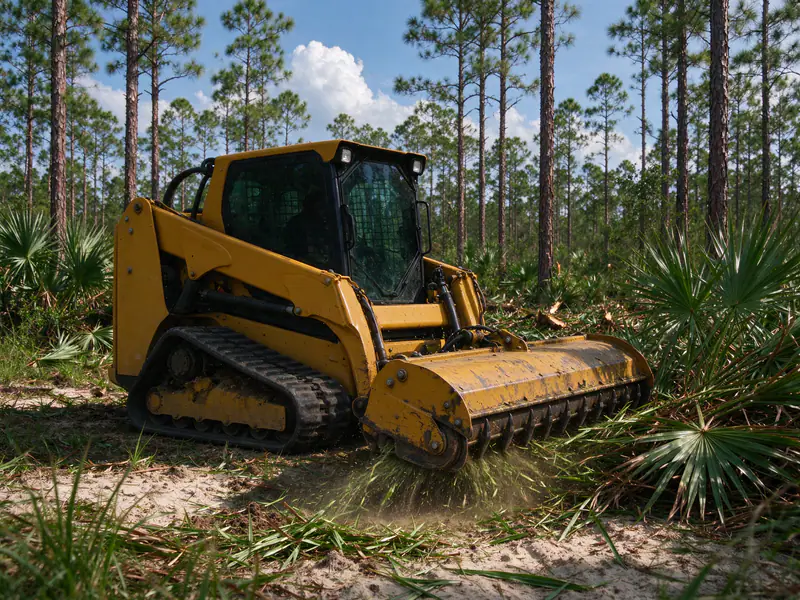
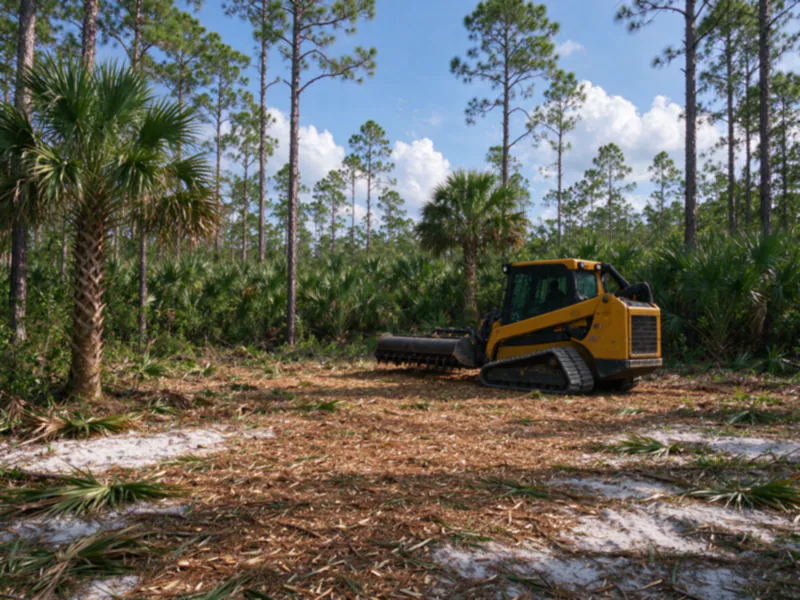
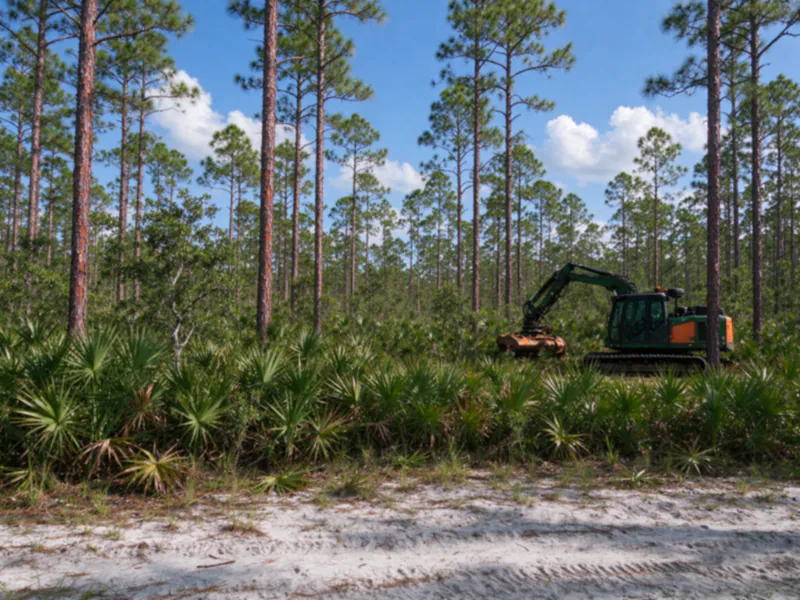
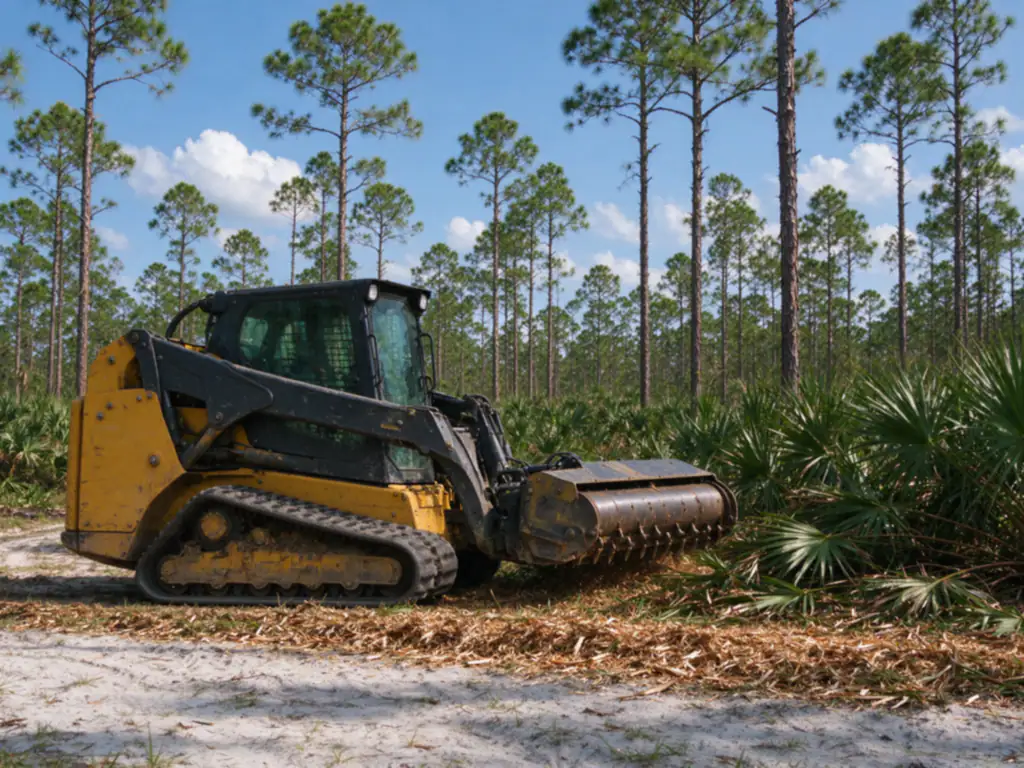
Flatwood Land Clearing Palm Bay provides forestry mulching in Palm Bay and the surrounding south Brevard towns, for owners who want the understory gone and the trees left standing. Forestry mulching means a rotating drum of hardened teeth, mounted on a tracked machine, grinds palmetto, brush, vines and small trees where they stand and spreads what is left across the ground. Nothing is piled, loaded or burned. On a Palm Bay pine flatwoods lot, that makes it the quickest way to turn a wall of saw palmetto into open woods. The work is carried out by licensed and insured contractors, and the scope says plainly what mulching leaves behind.
What happens on the first visit
The first visit sets the boundary and the keepers. Mulching is a finish for ground that will stay wooded or become yard, so the walk starts with what the area is for. If part of it will become a house pad, driveway or septic drainfield, that part is marked for clearing and grubbing instead, because the roots have to come out there.
Inside the mulching area the walk marks the trees you want kept, usually slash pines and cabbage palms, and checks how close the mulcher can work to each one. Palm Bay’s code protects a kept tree’s critical root zone, a circle 12 inches across for every inch of trunk diameter and never less than 10 feet, and asks that underbrush inside it be cleared by hand. A mulcher’s teeth reach into the soil, so the scope shows where the machine stops.
The walk also looks for gopher tortoise burrows. The open, sandy patches between palmetto clumps are where they dig, and the Florida Fish and Wildlife Conservation Commission requires a relocation permit before any work within 25 feet of a burrow. A mulcher shredding palmetto over a burrow mouth is that kind of work. Finally it checks the ground. A tracked carrier spreads its weight well, but after a week of summer rain Palm Bay’s flatwoods sand can be soft enough to churn.
How a mulching head works on palmetto and pine
The mulching head is a horizontal drum, often around the width of the machine, lined with fixed teeth or swinging hammers. It spins fast enough to shred whatever it is lowered onto. The operator walks the head into a palmetto clump from the top down, then over the ground the clump stood on, and moves on in overlapping passes. Small trees are fed in from the top or pushed over and ground along their length.
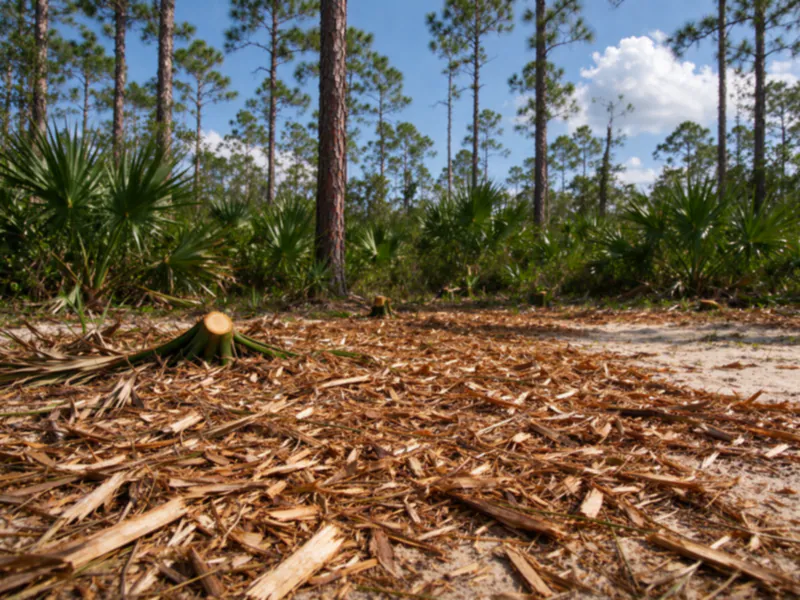
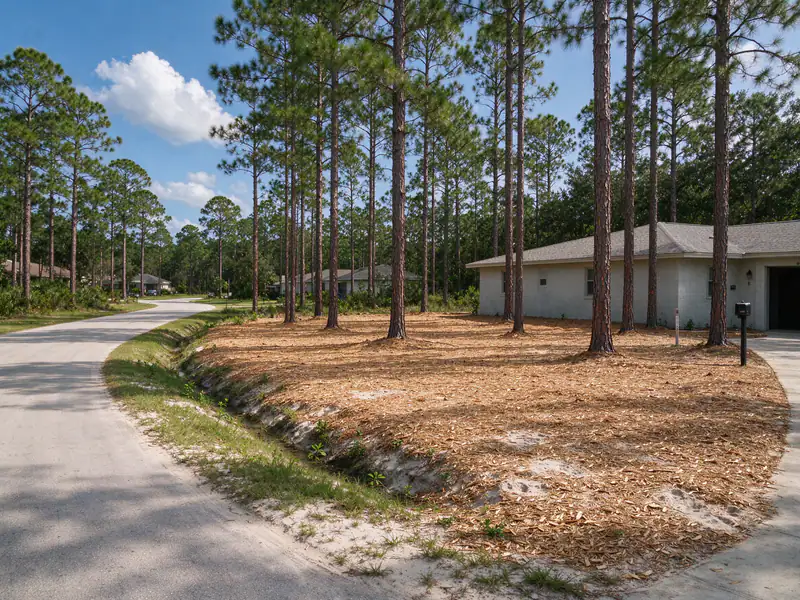
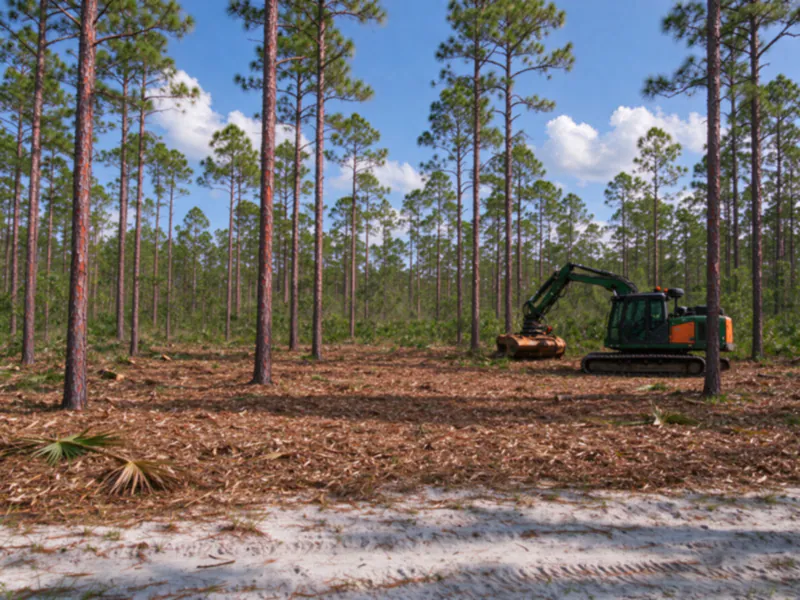
What comes out is a mat of shredded fiber and wood chips. On a Palm Bay lot it is mostly saw palmetto, which shreds into a stringy, coarse layer, mixed with wax myrtle, gallberry, vines and pine saplings. That layer stays where it falls. It shades the sand, holds it in place in a summer downpour, and breaks down over time. Melbourne gets about 50.79 inches of rain in a normal year, roughly 55 percent of it from June through September, and a mulched floor handles that rain far better than scraped sand, which washes into swales and onto the street.
The limit is depth. The head shreds what is at and just below the surface. Saw palmetto’s trunks run along the ground and just under the sand, the “gator backs” owners describe, and roots go deeper. A mulcher run hard into the sand can grind some trunk, but it wears the teeth quickly and cannot clear the root mass the way a root rake or grubbing bucket does. Mulching takes the top off the problem, and that is all it claims to do.
What mulching leaves behind, and when that matters
Forestry mulching does not remove roots, and every quote for it should say so. After the machine leaves you have standing trees, a layer of chips and, under that, every root and palmetto trunk that was there before.
For woods you are keeping, that is the point. The kept pines keep their roots undisturbed, the soil stays covered and the lot looks open from the street. For a lot being held, sold or made walkable, it is a fraction of the work of a full clear.
For ground that will be built on, it is the wrong finish. Chips and roots under a slab or a load of fill break down and leave soft spots, and a pad built over them can settle. That is why the house pad, driveway and drainfield on a Palm Bay lot are grubbed rather than mulched, as laid out in forestry mulching vs land clearing. A forestry mulched lot that is later sold for building will still need its building areas grubbed, so the mulching does not save that step.
Regrowth is the other cost. Palmetto resprouts from the trunks left in the sand, Brazilian pepper resprouts from its stump and roots, and both come back faster than most owners expect. A mulched area stays open with periodic mowing, which the after land clearing guide covers. For pepper, mulching the top is not enough; on a lot being developed, Palm Bay requires Class I invasives to be removed before the certificate of occupancy.
Permits for mulching in Palm Bay
Palm Bay’s Chapter 175 names mulching in place, with hand clearing and roto-chopping, as a method of grubbing, which the code uses for removing underbrush. A grubbing permit does not allow scraping, filling or removing protected or specimen trees. One- and two-family residential sites under an acre, and any site where the area being grubbed is a quarter acre or less, are exempt from the grubbing permit.
Trees are a separate question. Any tree with a trunk of 6 inches or more at breast height, or a palm with 4.5 feet of clear wood, needs the city’s tree removal permit to come down, and any land clearing on a residential lot under an acre falls under that same permit. So a mulching job that stays in the underbrush is on a different footing from one that takes out pines. Whether a particular job counts as underbrush work or land clearing is confirmed with the city per address, and the Palm Bay permit guide explains each permit.
Outside city limits, unincorporated Brevard County’s small-scale land clearing permit allows up to half the understory or one acre, whichever is less, for $240, and does not cover wetland impacts or protected species.
Not sure if mulching is the right finish?
Tell us what the ground is for and send a few phone photos. The scope says which parts to mulch and which need grubbing.
What forestry mulching costs
As national budgeting ranges, forestry mulching runs about $125 to $300 per machine hour with an operator, or $400 to $800 per acre for typical growth and up to about $2,000 per acre for dense growth. Day rates run about $1,000 to $2,500, job minimums about $400 to $600, and some jobs carry a mobilization fee of $150 to $300 for bringing the machine in.
On a Palm Bay lot the hours go up with continuous mature palmetto, pepper thickets, many saplings near kept trees and wet ground that slows the machine. They go down on open pine with scattered brush. Because nothing is hauled, mulching avoids the loading and disposal costs that make up a large share of a full lot clear. The forestry mulching cost guide breaks the price down, and the cost estimator gives a range for your acreage. Where only light brush and grass are involved, brush clearing with a mower may be the cheaper tool.
What a forestry mulching scope includes
- A walk of the area to mark the boundary, the trees you keep and any burrows or wet spots
- A written scope naming what gets mulched, what stays and the finish you can expect
- Root zone barricades or a hand-cleared ring around kept trees before the mulcher runs
- Palmetto, brush, vines and small trees mulched in place in controlled passes
- Mulch left spread across the worked area rather than piled
- Stumps of mulched saplings taken down close to the ground
- A hand-off walk of the mulched area against the scope, with regrowth expectations stated
Forestry mulching, bush hogging or clearing and grubbing
| Forestry mulching | Bush hogging | Clearing and grubbing | |
|---|---|---|---|
| What it handles | Palmetto, brush, vines and trees up to the size the head can take | Grass, weeds and light brush; stalls on mature palmetto and saplings | Everything, including stumps and the root layer |
| What is left on the ground | A layer of shredded wood and palmetto over the sand | Cut stems lying on top, roots untouched | Bare sand; debris hauled, chipped or piled |
| Roots and palmetto trunks | Stay in the ground and resprout | Stay in the ground and resprout | Removed from the grubbed areas |
| Ground disturbance | Low; one tracked machine, soil not scraped | Low on dry ground; a tractor can rut wet sand | High; soil turned over and exposed |
| Best fit | Woods you are keeping, trails, view corridors, a lot held for later | Keeping an already open lot or field mowed | House pad, driveway, septic area |
On most Palm Bay house lots the answer is a mix: grubbing where the house goes and mulching at the edges that stay wooded.