Last Updated:
Flatwood Land Clearing Palm Bay offers selective land clearing across Palm Bay and south Brevard: the underbrush, the Brazilian pepper and the trees you choose to lose come out, and the pines, oaks and cabbage palms you choose to keep stay standing and healthy. It is the opposite of starting a machine at one corner of the lot. Selective clearing starts from the keepers, plans around them, and only then removes the rest. The work is carried out by licensed and insured contractors, with the keep-and-remove list written down before anything is cut.
What happens on the first visit
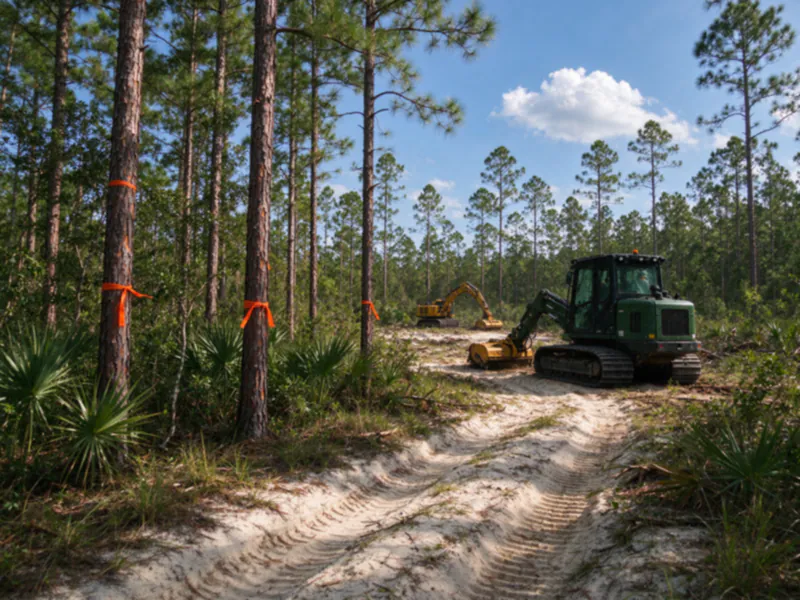
The walk is mostly about trees. Each candidate keeper is measured at breast height, because trunk diameter sets both the size of its protection zone and how much it counts toward the city’s landscaping requirement. Each one is checked for the things that make a poor keeper: a dead or broken top, a heavy lean toward the house site, damage or rot at the base, or a position so close to the pad that the builder could not work around it. Palm Bay’s code asks for kept trees to be marked on site with bands or flagging that match the approved plan, so the flagging done on this walk is the same flagging the permit sketch will show.
The walk also looks at the ground between the trees. Machine routes have to reach every area being cleared without crossing a root zone, so a lot with keepers scattered across the middle may need hand work where a machine cannot fit. Burrows are checked too, since FWC requires a gopher tortoise permit before any work within 25 feet of one, and so is wet ground, which on Palm Bay sand decides whether a tracked machine can work without rutting.
Root zones decide the job
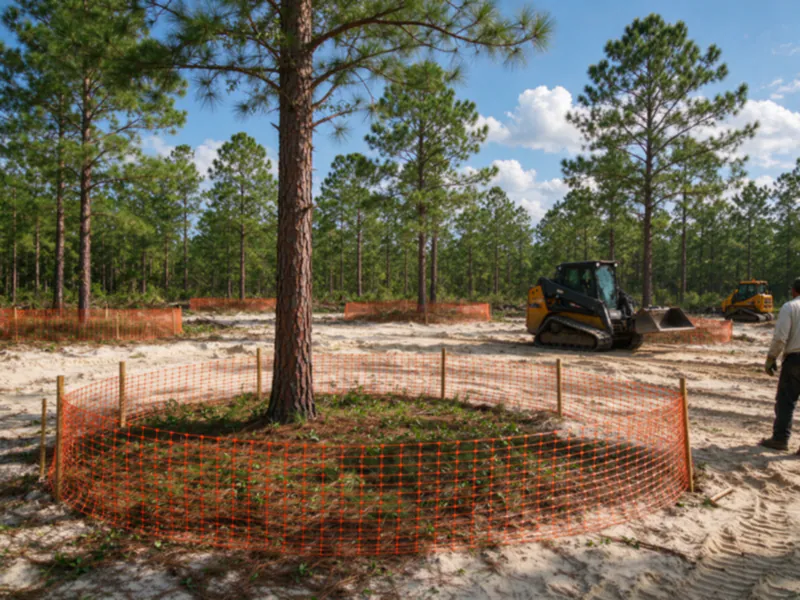
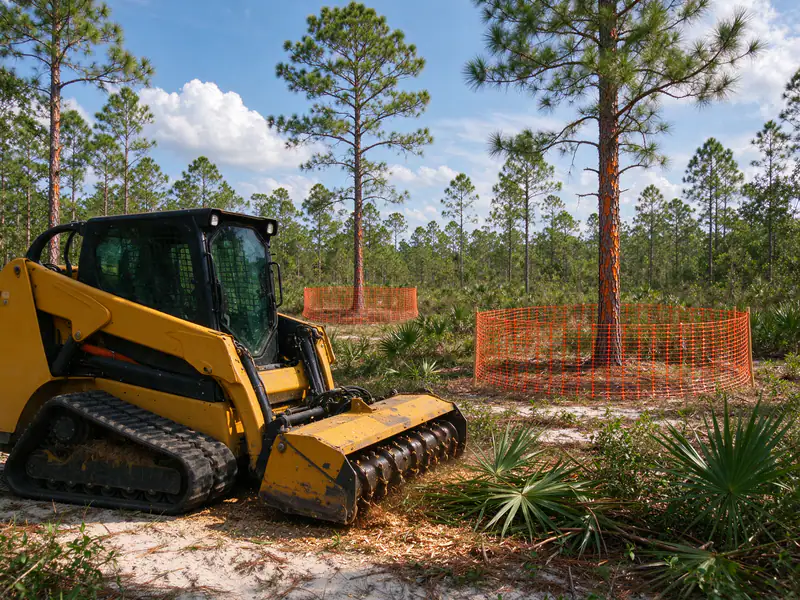
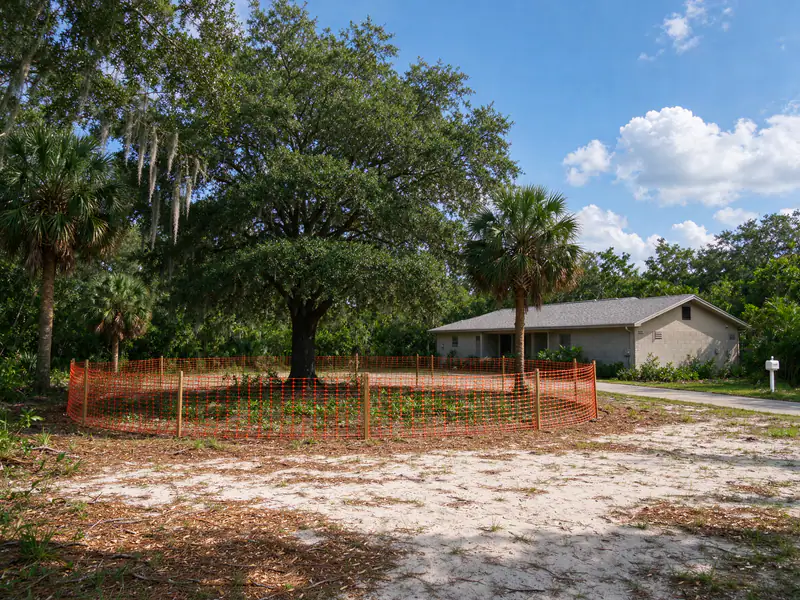
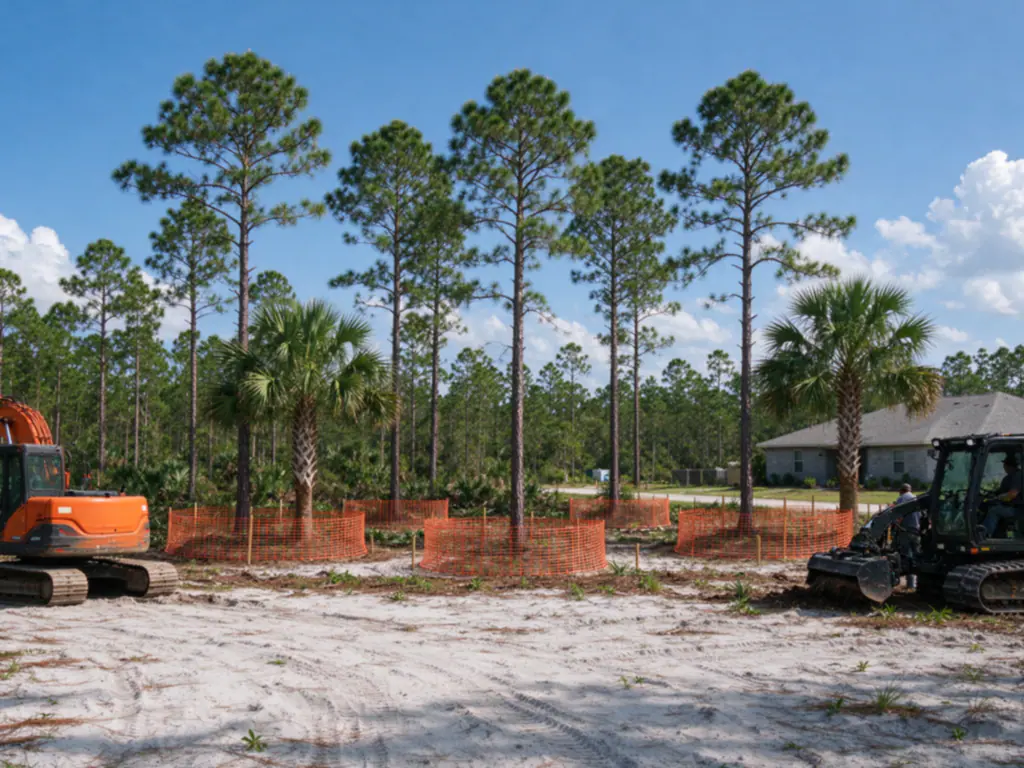
A tree’s roots spread far wider than its trunk and most of them sit in the top of the soil. Palm Bay’s code turns that into a rule. Under §175.003, each kept tree gets a critical root zone of 12 inches of diameter for every inch of trunk diameter, and a visible barricade at that line or 10 feet from the trunk, whichever is greater. A 24-inch slash pine has a root zone 24 feet across, so its fence sits about 12 feet out; for trees under 20 inches the 10-foot minimum governs. Palms get 3 feet. Where four or more trees stand together, the protection is drawn as a limit of development at least 12 feet beyond the outermost trunks.
Inside the barricade, the rules are strict. Underbrush is cleared by hand. No machines, materials or soil go inside, nothing is nailed to the tree, felled wood is carried out promptly, and the natural soil level is kept. Trenching through the zone is avoided, and where a utility line has to pass a kept tree the code points to tunneling instead.
The reason is the way trees fail after clearing. A machine driven over the roots compacts the sand and tears the fine roots that take up water, and fill piled against the trunk smothers the root flare. Neither kills a tree on the day. The decline can show months later as thinning and dieback, long after the lot looks finished, which is why the protection goes up first and stays up.
Kept trees pay you back at the certificate of occupancy
A new one- or two-family home lot under an acre in Palm Bay needs four trees and ten shrubs before the certificate of occupancy, under §175.021, and half of any trees planted have to be native canopy species. Kept trees count toward that number, and generously:
- A kept tree of 6 to under 12 inches counts as three trees.
- A kept tree of 12 to under 20 inches counts as four.
- A kept tree of 20 inches or more counts as five.
- Palms with at least 4.5 feet of clear wood count one for one, up to half of the trees required.
So one sound 14-inch pine left beside the driveway covers the whole tree requirement. The tree has to stand inside the property lines, though, not in a right-of-way or easement, so a big pine on the swale or in the canal easement does not count. The Palm Bay permit guide covers how kept trees appear on the site sketch, and the house lot guide shows where the decision fits in the build sequence.
Want to know which trees are worth keeping?
Send a few phone photos of the trees you like and a sketch of where the house will sit. The keep list starts from there.
Underbrush, heavy undergrowth and invasives under kept trees
Much selective work is underbrush removal: the palmetto, vines, saplings and pepper that fill the space under a pine canopy. Outside the root zones that layer can be mulched or cut and hauled; inside them it is cut by hand. Saw palmetto resprouts from trunks left in the sand, so cutting it back under a kept tree is maintenance, not removal, and the scope says so. Where palmetto has to go for good, see saw palmetto clearing.
Brazilian pepper is the exception to keeping things. It is on Florida’s noxious weed list, and Palm Bay requires Class I invasives on a property being developed to be removed before the certificate of occupancy, so a pepper growing up through a kept oak comes out with its root crown, carefully, by hand.
On a lot that is being kept rather than built on, thinning the understory has another reason. After the 2008 Mother’s Day fires, which destroyed 33 homes in Palm Bay, the city’s fire department advised clearing dense brush at least 30 feet from homes. Opening the understory while keeping the canopy is selective clearing by another name, and brush clearing covers the wider job.
In Palm Bay, underbrush removal on its own needs no grubbing permit on a one- or two-family site under an acre, or on any area of a quarter acre or less. Larger sites need one, with a sketch of every tree in and around the area.
Trails and paths through kept woods
On acreage in Malabar, Grant-Valkaria and the edges of Palm Bay, selective clearing often means a path rather than an opening: a walking trail, a cart path or an access lane wound between the trees worth keeping. The route is flagged on the walk to bend around root zones instead of through them, cleared to a set width, and usually mulched as the tread, which keeps the sand from washing in summer rain. The Malabar and Grant-Valkaria pages cover the local rules on acreage.
Selective clearing outside Palm Bay
Neighboring jurisdictions build selective clearing into their rules in different ways. Unincorporated Brevard’s small-scale land clearing permit allows up to half of a site’s understory or one acre, whichever is less, and up to 10 percent of the native canopy, and it does not allow viable specimen trees of 24 inches or more to come out, so on a vacant county parcel selective clearing is the permit. Rockledge requires four trees to remain on a property after a residential tree removal, as the Rockledge page notes. Sebastian sizes its barricades differently, at 5 feet for trees up to 10 inches and 10 feet plus a foot for every inch beyond that, as the Sebastian page explains. Any other local rule is confirmed per address.
What a selective clearing scope includes
- A walk of the lot to choose keepers, with trunk diameters measured and each tree flagged
- A check of each keeper for dead tops, heavy lean, damage and closeness to the house plan
- A written scope listing what stays, what goes and the machine routes between them
- Root zone barricades set before any machine moves
- Underbrush inside the root zones cleared by hand
- Brazilian pepper and other Class I invasives removed with the root crown
- Chosen trees felled into planned drop zones away from the keepers
- Debris chipped, mulched outside the root zones or hauled
- A hand-off walk of the kept trees and barricades against the scope
Full clearing, selective clearing and underbrush thinning
| Full clearing | Selective clearing | Underbrush thinning | |
|---|---|---|---|
| What comes out | Every tree, shrub, stump and root | Chosen trees, invasives and the underbrush around the keepers | Brush, palmetto, vines and saplings; trees stay |
| Machine work | Open across the lot | Along set routes, outside every root zone barricade | Light machines or mulching outside root zones, hand work inside |
| Tree credit at the CO | None, so all required trees are planted | Kept 6 to 12 inch trees count as three trees each | Most trees stay and count |
| Pace | Fastest per acre | Slower: more hand work and more planned felling | Moderate |
| Best fit | A tight lot the house and septic fill | A lot with good pines or palms clear of the building areas | A wooded lot being kept, walked or made less fire-prone |
Selective clearing costs more per acre in labor and planning, and often less in replacement trees, mitigation and lost shade.