Last Updated:
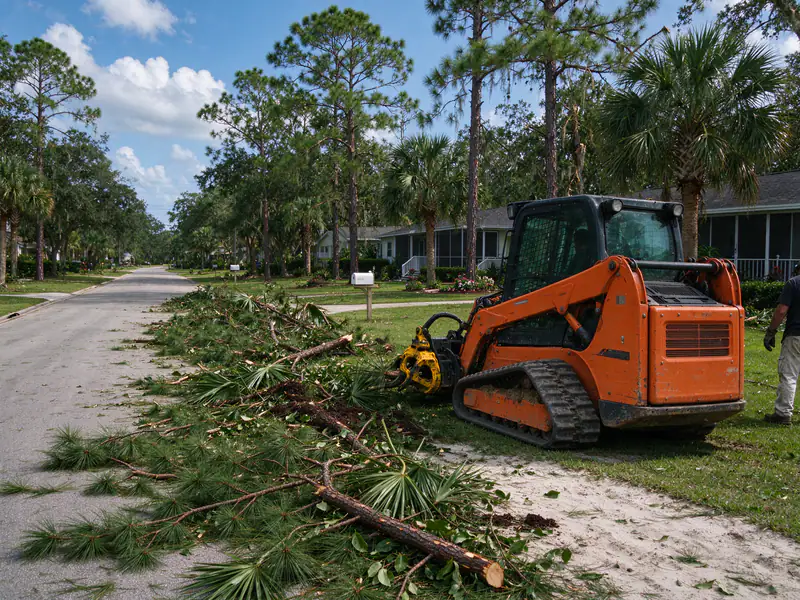
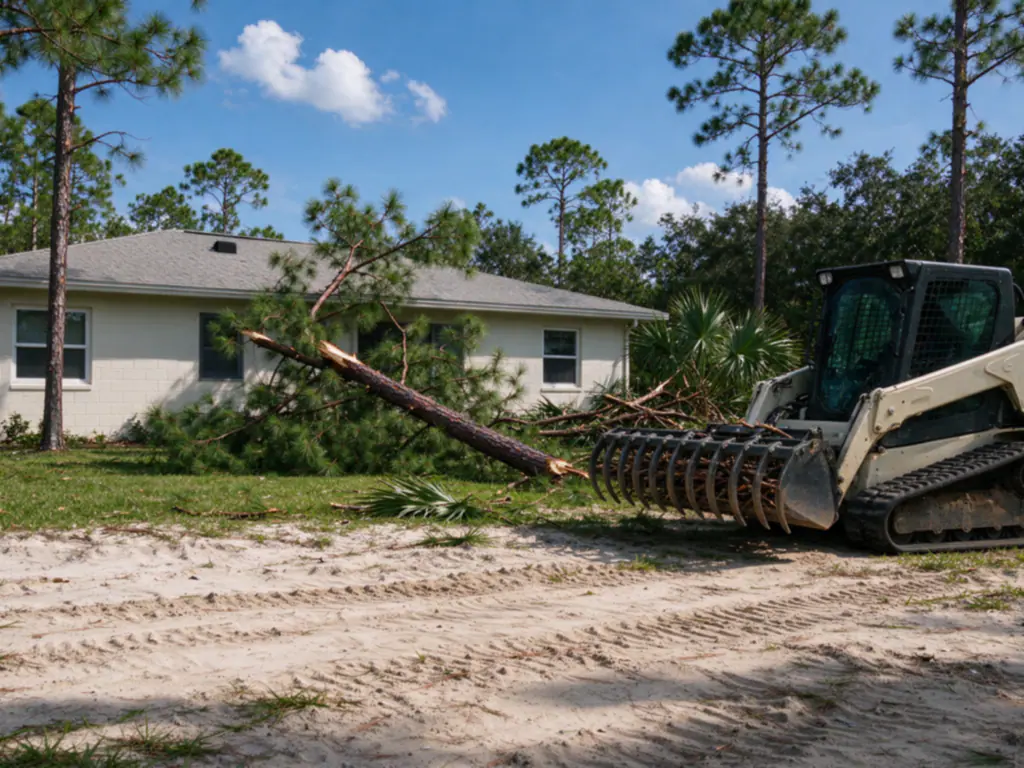
Flatwood Land Clearing Palm Bay handles storm debris cleanup in Palm Bay and across south Brevard: fallen pines, snapped tops, torn limbs and wind-thrown trees cleared from back yards, vacant lots and acreage after a hurricane or a severe summer storm. This is scheduled cleanup, booked and scoped like any other clearing job once the storm has passed and the property is safe to work. It is not an on-call or rapid-response service. The work is carried out by licensed and insured contractors, from a written scope that separates the wood lying on the ground from the trees that are still hung up or standing damaged, because those are different jobs for different hands.
Before anyone cuts
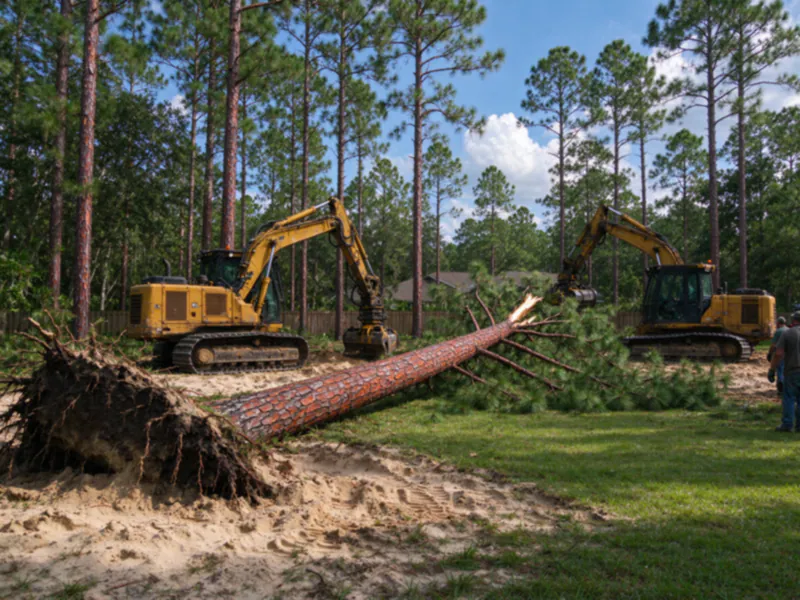
Storm wood is more dangerous than it looks. A pine bent under another tree, or a limb pinned under a trunk, stores energy like a drawn bow, and when it is cut it can spring free with enough force to injure someone standing nearby. Trees resting on other trees can drop without warning. A pine tipped over with its root plate in the air can settle back toward its hole once the trunk is cut free of it. None of this is work for a homeowner with a chainsaw, and none of it is treated like pushing over brush.
Lines come first. Any tree touching or tangled in an overhead line is the power company’s to make safe, whether the line looks dead or not, and nothing near it is touched until that is done. A tree lying on a roof is held in place by the structure and can roll or shift when cut; taking it off is arborist rigging work, and the scope says so rather than folding it into the cleanup.
What happens on the first visit
The visit sorts the property into three kinds of damage. There is the wood already on the ground: snapped tops, torn limbs and trees that came all the way down. There are the trees hung up in other trees, leaning on a structure, or tipped with a lifted root plate. And there are standing trees with damage that may not come down until the next storm, such as a split trunk, a broken top or a cracked limb still in the crown. The first group is clearing work. The second and third may need an arborist’s rigging or assessment first.
The walk also checks the ground. Palm Bay’s soils are mostly poorly drained sand, and from June through November the wet layer sits about a foot below the surface in the most common soil type, per the USDA soil survey: the same months as hurricane season. After heavy rain a loaded machine can rut a yard badly, so a job may be walked and scoped first and worked once the ground firms. It looks for gopher tortoise burrows too, since the FWC permit rule for work within 25 feet of one does not pause after a storm.
Palm Bay’s storm rules for trees
The city’s tree code still applies after a storm, but it has provisions written for one. Under §175.002, removing diseased or fallen trees, or trees weakened by age, storm or fire, is an approved reason for removal. Under §175.014(A)(7), when a tree poses an immediate threat to people or property and has to come out at once, the City Manager or a designee can give on-site verbal authorization to remove it without the usual permit. Under §175.014(A)(8), when a public emergency is declared because of a hurricane or other natural disaster, the provisions of the tree code may be suspended; what that covers, and for how long, depends on the declaration, so it is checked at the time rather than assumed.
State law adds a separate route for home lots. Florida Statute 163.045 says a local government cannot require a notice, permit, fee or replanting to prune, trim or remove a tree on residential property, meaning a single-family detached home lot in residential use, when the owner has documentation from an ISA-certified arborist or a Florida licensed landscape architect that the tree poses an unacceptable risk. Palm Bay’s code recognizes it for developed one- and two-family lots that provide the city with that documentation. It does not cover a vacant lot, and it does not apply to mangroves.
A lot partway through clearing when the storm hits has one more rule to know. Under §175.012, the city can require a new application and full review of a permit renewal where wind, hurricane, flooding or fire has substantially changed the site since the permit was issued. The Palm Bay permit guide covers the permits themselves.
Nearby cities draw the lines differently. Melbourne exempts existing one-, two- and three-family homes from its tree removal permit, and Titusville needs no tree removal permit from the owner of an existing single-family home. Melbourne Village requires a permit to remove any tree, dead ones included. The Melbourne and Titusville pages cover those cities; anywhere else, the rule is confirmed per address.
Trees down on your property?
Send a few phone photos of what came down and what is still standing damaged. The scope starts from there.
Root plates, stumps and holes
A wind-thrown pine leaves a different problem from a cut one: a disc of roots and sand standing on edge and a hole where it stood. The trunk is cut free first, in a planned order so the plate does not swing back unexpectedly, and then the plate is either set back and the stump ground, or pulled out and the hole backfilled. Which one depends on what the ground is for. Under lawn, stump grinding after the plate is set back is usually enough; where something will be built, the stump and roots come out entirely, as on the clearing and grubbing page.
Where storm debris goes
Storm wood goes the same places as any land clearing debris, and it is sorted first. Roofing, fencing, siding and other storm trash mixed into a load of wood changes how the load is charged at the disposal site, per the county’s posted gate rates, so trash is pulled out and hauled as its own load. In Melbourne, yard waste produced by tree removal workers has to be disposed of by the contractor rather than left for the city’s hauler. Whether a city or the county runs a separate curbside storm collection after a given storm, and what it takes, depends on the event, so check its announcements before stacking anything at the street.
Burning storm debris follows the same Florida Forest Service rule as any land clearing pile: an authorization, and at least 300 feet from any occupied building, 50 feet from brush and woods and 100 feet from a paved road. On a Palm Bay house lot that rules it out, and the city’s fire chief has banned open burning in dry spells. The debris hauling page and burning land clearing debris set out the options.
Swales and canals matter more than usual after a storm. Palm Bay’s GIS maps roughly 395 miles of drainage canal lines across the city, and wood pushed into a canal or left in a swale blocks the drainage the next storm needs.
Downed wood on vacant lots and acreage
Storms also leave vacant lots and wooded acreage full of downed pines that nobody cleans up. That wood dries out over the winter and becomes fuel in the spring fire season. After the 2008 Mother’s Day fires, which destroyed 33 homes in Palm Bay, the city’s fire department advised clearing dense brush at least 30 feet from homes, and storm-downed pine on a lot next to a house falls into the same category. On open acreage, downed wood can often be mulched in place; on a vacant lot heading for a code notice, overgrown lot clearing covers the wider job. What a property needs once the wood is gone is in what to do after land clearing.
What a storm debris cleanup scope includes
- A walk of the property once the utility has made any downed lines safe
- A sort of what is on the ground, what is hung up and what is standing but damaged
- A written scope that names any tree needing an arborist's rigging and leaves it to that trade
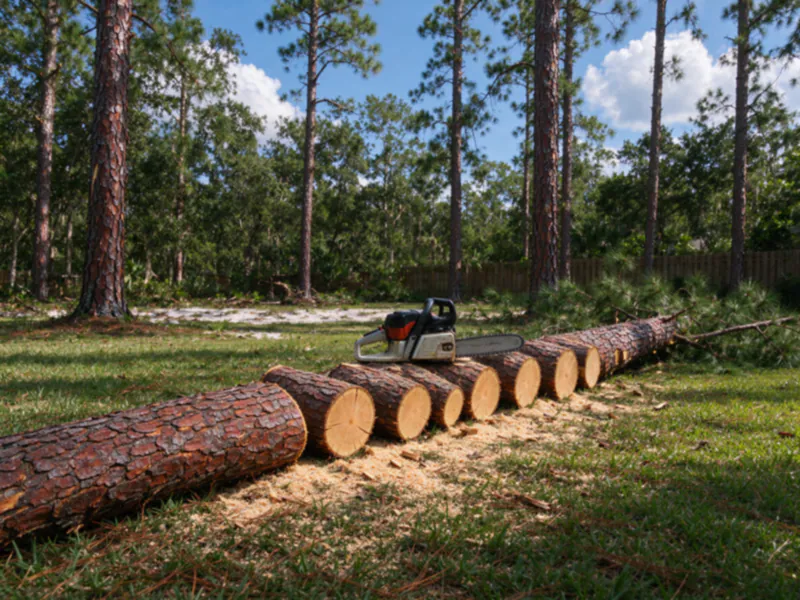
- Fallen trees and limbs on the ground cut into manageable lengths
- Wind-thrown root plates cut free and the stump dealt with as the scope says
- Wood sorted from roofing, fencing and other storm trash
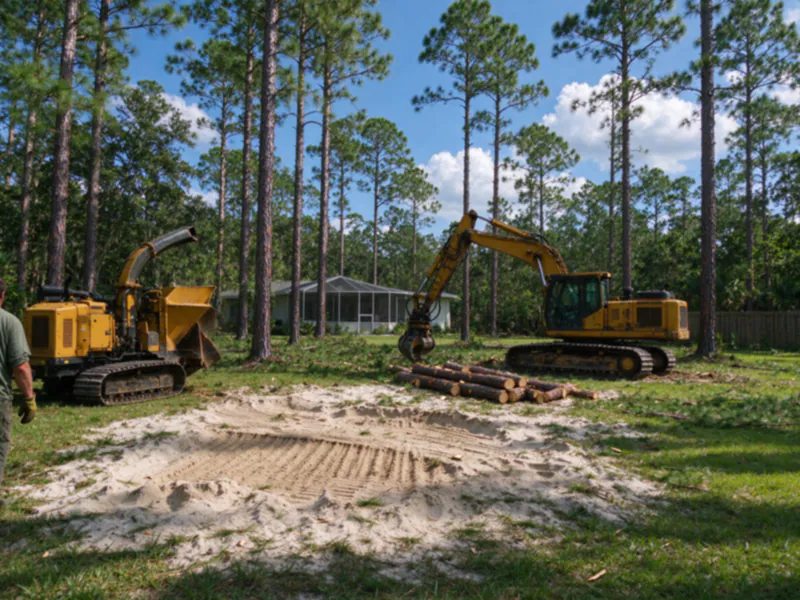
- Debris chipped, hauled to a site that accepts it, or mulched in place on open land
- Swales and canal easements left clear of wood
- A hand-off walk of the cleared yard or lot against the scope
Three kinds of storm damage, three different jobs
| Wood on the ground | Trees hung up or leaning | Standing trees with damage | |
|---|---|---|---|
| What it looks like | Snapped tops, torn limbs and trees already down | Trees caught in other trees, resting on a roof or line, or leaning with a lifted root plate | Broken tops, split trunks or cracked limbs still in the canopy |
| Main hazard | Spring poles and wood under tension | Sudden release or a second fall | Falling parts later |
| Who handles it | Clearing work: cut, sort, chip or haul | An arborist with rigging, or the utility for lines | An arborist's assessment, then removal if it is warranted |
| City permit question | Usually about the standing trees, not the wood already down | Immediate threat: on-site verbal authorization from the city | Approved reason under the code; F.S. 163.045 documentation on a home lot |
Most storm jobs include all three. The scope separates them so each part goes to the right hands.