Understory and vines
Brush clearing
Underbrush, vines and saplings cut or mulched to ground level, under the trees you keep, with a straight answer about what grows back and how fast.

Range plate · Rockledge, Brevard County
Rockledge asks for a tree permit even at an existing house, and at least four trees have to remain on the property afterwards. Vacant lots also carry a standing rule: a 10-foot strip along the neighbors and the street kept cut short.
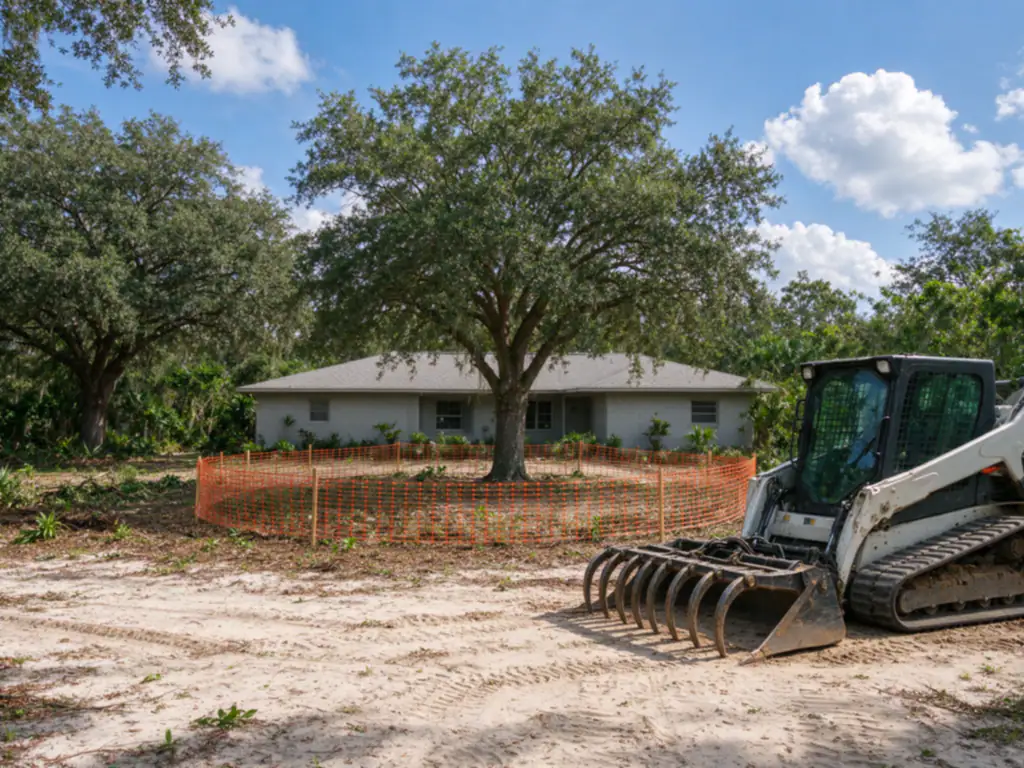 Plate. A Rockledge home site, Brevard County
Legend What changes a clearing job in Rockledge
Key to the parcel
Rockledge requires a permit and a layout of the yard showing every tree, even for a homeowner. The sketch is part of the job, not an extra.
see Selective clearingUndergrowth in a 10-foot strip along improved lots, sidewalks and streets must stay at 12 inches or less, which makes a recurring brush cut, not a one-off.
see Brush clearingWhere vines, brush and saplings have taken a lot over, a first heavy cut opens it, and the four-tree rule decides which trees are kept.
see Overgrown lot clearingMost vacant lots in town sit in two subdivisions. Clearing for the house works around the trees that must stay and the city's land disturbing permit.
see Lot clearingServices
Understory and vines
Underbrush, vines and saplings cut or mulched to ground level, under the trees you keep, with a straight answer about what grows back and how fast.
Pinus elliottii, Sabal palmetto
Unwanted growth out and the keepers flagged and fenced at the root zone the city sizes from trunk diameter, so the trees you save still count on the landscape plan.
Years of regrowth
A vacant lot left for years, with brush, vines and dumped debris, cut back to ground that can be mowed, surveyed, sold or built on.
Residential platted lot
A platted lot opened to the site plan: trees and palmetto out where the house, driveway and septic go, marked keepers protected, and stumps handled to the finish the builder needs.
Below-grade grind
Stumps ground below grade where lawn, driveway or path will go. The grindings refill the hole or are hauled away, and the roots past the grind decay slowly in the sand.
Method: mulching head
Brush, palmetto and small trees shredded where they stand into a mulch layer. Roots and stumps stay in the ground, so it opens land without turning it into a building pad.
Field procedure
The address, whether there is a house on the lot, and what should go or stay. How many trees the lot has today comes up early.
The trees are counted and keepers chosen, and the visit checks for gopher tortoise burrows, wet ground and room to work beside the neighbors.
The scope includes the yard layout the city asks for, the trees to remove and the four or more to keep, the stump plan and the debris route.
Once the permit is issued, keepers are protected and the work is done; the hand-off walk confirms what remains against the permit.
Last Updated:
A vacant lot in Rockledge comes with a standing chore: undergrowth in a 10-foot strip along any neighbor’s improved lot, sidewalk, street or bike path has to stay cut to 12 inches or less. That upkeep, and the larger clearing jobs, are what Flatwood Land Clearing Palm Bay takes on in Rockledge through licensed and insured contractors, in a city that permits tree removal even at existing homes and keeps at least four trees on every lot.
The City of Rockledge’s answer to “Do I need a permit to remove a tree?” is yes, along with a layout of the yard showing where every tree is and which one is coming out. That holds for a homeowner, which sets Rockledge apart from Titusville, where an existing house is exempt. Tree removal is a permit type the Building Division issues itself, and land disturbing activity is listed as its own permit line. The city pages read for this page do not state the trunk size that triggers the permit or the fee, so both are confirmed per address before the work is scheduled. One statewide exception sits on top of the city rule. Florida Statute 163.045 bars a local government from requiring a permit, fee or replanting to remove a tree on a single-family home lot when the owner has documentation from an ISA-certified arborist or a Florida licensed landscape architect that the tree poses an unacceptable risk. Short of that documentation, the city permit applies. For a homeowner taking out one tree, the job is usually a single removal followed by stump grinding, but the permit and the sketch come first either way.
Rockledge’s residential permit requirements add a floor: once the permitted trees are removed, at least four must remain on the property. The application shows every tree on the lot and the ones to come out, on a survey or a hand-drawn sketch. So a Rockledge lot is never cleared to bare sand under a residential tree permit, and the clearing plan starts by choosing the four. Sound trees away from the house, driveway and drainfield are the usual choices, because a tree whose roots are cut by the foundation work may not survive to count. Selective clearing keeps machines out of their root zones. Whether the four-tree count applies the same way to a vacant lot before a building permit is not stated on the city’s page, and it is confirmed per address.
The city’s FAQ describes Code Sections 16-2 and 16-45 this way: vacant residential or commercial property must keep untended vegetation, grass and undergrowth cut to 12 inches or less in a 10-foot strip along any abutting improved lot, sidewalk, street or bike path. That makes vacant-lot ownership in Rockledge a recurring brush clearing job rather than a one-time clear. A lot that has been left for years first needs a heavier cut, the kind covered by overgrown lot clearing, and after that a periodic pass with a mower or mulching head keeps the strip within the rule. The mulching versus bush hogging guide compares the two machines for that work, and clearing land yourself or hiring it out helps with the choice for a small strip.
Beyond the tree permit, Rockledge lists land disturbing activity as work that needs its own permit. Site plan submittals go further, with two sealed tree surveys and two copies of the erosion and sedimentation control permit application. For a single house lot, that means the clearing plan and the erosion plan are drawn together, and bare sand is covered or fenced before the next rain carries it toward the street. The erosion control guide explains the usual measures, and a lot clearing scope names which of them the clearing contractor leaves in place for the builder.
Brevard County’s parcel data counts 455 vacant platted single-family lots in Rockledge averaging 0.19 acres, and 329 of them sit in the Catamaran Cove Phase I and II replat, with 77 more in Reserve at Turtle Creek Phase 1. The city’s 8,971 homes average about a quarter acre. New single-family permits have swung widely, from 21 for 2021 to 237 for 2023 and 131 for 2025, by the Census Bureau’s count. One historical scrub-jay polygon on the county map, about 1,099 acres, takes in part of Rockledge and part of Viera East, with 24 families counted in 1993 and 7 in 2000 to 2002. A lot with scrub on it is screened before clearing, as the scrub-jay guide explains.
Method
Because a lot cannot be taken to zero trees, the keepers are picked first: sound trees away from the house, drive and drainfield, so they survive the work and still count.
A vacant lot kept to the 10-foot rule with a periodic brush cut rarely needs the heavier, costlier first cut that a lot left for years does.
Range
City of Rockledge Building Division, City Hall, 1600 Huntington Lane; 321-221-7540, option 2. The tree size that needs a permit, and the fee, are confirmed per address with the division.
Notes
Yes. The City of Rockledge requires a tree removal permit, along with a layout of the yard showing where all the trees are and which one is coming out, and that applies to owners of existing homes as well as to vacant lots. The Building Division issues the tree removal permit itself.
The city's residential permit requirements say there must be four trees remaining on the property once the permitted trees are removed, with a survey or hand-drawn sketch showing all trees on the lot and those to be removed. Whether that count applies the same way to a vacant lot before a building permit is confirmed per address.
Rockledge's code, as the city's FAQ describes it, requires vacant residential and commercial property to keep untended vegetation, grass and undergrowth cut to 12 inches or less in a 10-foot strip along any abutting improved lot, sidewalk, street or bike path. That is a maintenance cut, repeated as the brush grows back.
National budgeting ranges put an eighth-acre lot at about $600 to $2,000 and a quarter-acre lot at about $800 to $3,000, before grading, fill or survey. Rockledge's vacant lots average about a fifth of an acre. Keeping four trees, protecting their roots and hauling the debris move a lot within that range.
The city's permit pages say a permit is required to remove a tree but do not state a trunk-size threshold or a fee. Both are confirmed per address with the Rockledge Building Division before the work is scheduled, and the scope is written to whatever the permit requires.
Neighboring range
Estimate
Get an estimate for clearing in Rockledge
Send the address, whether it is a vacant lot or an existing home, and roughly how many trees are on the property now.
(321) 513-1820Outside these hours, emergency calls only.