Last Updated:
Flatwood Land Clearing Palm Bay handles Brazilian pepper tree removal in Palm Bay and nearby Brevard towns, from a single tree in a yard to thickets along fence lines, canal banks and the back of vacant lots. Brazilian pepper tree removal is not like cutting brush, because the plant does not die when it is cut. It resprouts from the stump and suckers from its roots, so the job is planned around the root crown: pulled out where a machine can reach it, or treated the moment it is cut where it cannot. The work is carried out by licensed and insured contractors.
What happens on the first visit
The visit maps the pepper and what it is tangled with. Brazilian pepper grows as a sprawling, many-stemmed shrub or small tree, often leaning and rooting where its branches touch the ground, and a thicket usually hides native trees, a fence, a septic tank lid or a canal bank. The walk tells pepper from the pines, oaks and cabbage palms you want to keep, and marks each area by method: crowns pulled in open ground, stumps cut and treated along fences, slopes and water.
It finds the property line, which a boundary survey makes certain. Palm Bay has about 395 miles of mapped canal lines, much of it in Melbourne-Tillman Water Control District, city or state right-of-way with common widths of 20, 30 and 50 feet, and a sunny canal bank is easy ground for pepper. The bank behind your fence may not be yours, and work in someone else’s right-of-way needs their permission first. Work close to the water also raises the questions covered in clearing near wetlands.
It also checks whether the property is being developed, because that changes what the city requires.
Why it is on the state list and the city’s
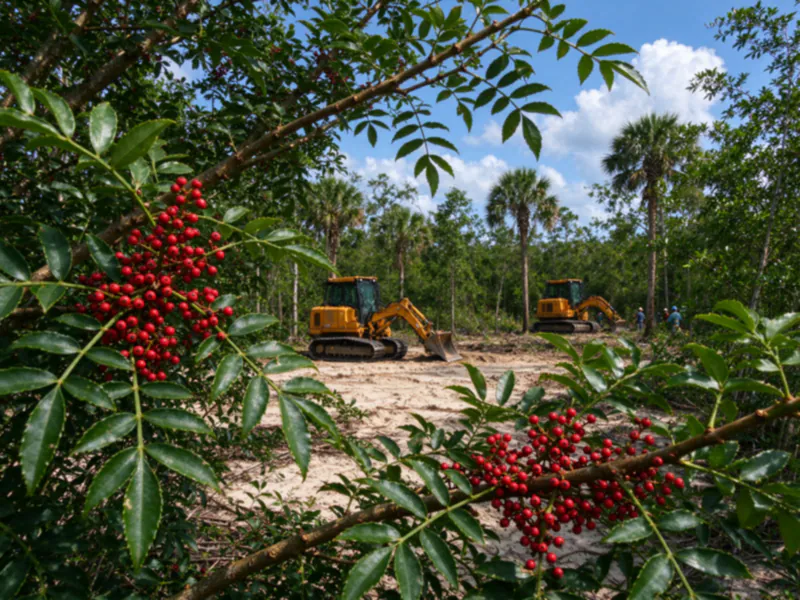
Brazilian pepper, Schinus terebinthifolia, came to Florida as an ornamental from South America and spread across the southern half of the state. UF/IFAS Extension describes it as one of Florida’s most invasive plants: it forms dense thickets that shade out native vegetation, and female trees bear heavy crops of red berries that birds carry to new ground. That is why it turns up along fence lines and under power lines, where birds perch.
Its legal status follows from that. The Florida Department of Agriculture and Consumer Services lists Brazilian pepper-tree on the Florida Noxious Weed List, Rule 5B-57.007, alongside cogongrass, air potato, melaleuca, small-leaved climbing fern and Australian pine. Melaleuca and Australian pine are handled the same way, and a selective clearing scope can take invasives out while the native trees stay. Palm Bay’s Chapter 175 prohibits all Class I invasive plant species on the Florida Invasive Species Council’s list and names Brazilian pepper among them.
Palm Bay’s certificate of occupancy rule
On a lot being developed, the rule is direct. Section 175.027(C) says that if prohibited species exist on the property at the time of development, they must be removed before the property receives a certificate of occupancy. They also cannot be counted toward the four trees and ten shrubs a new home lot under an acre needs before the CO, and they may not be planted. So on a house lot, pepper comes out with the rest of the clearing, including at the back fence and the edges you are otherwise keeping wooded.
For an existing home, the code treats removal of Class I invasives as an approved reason for removal, and section 175.014(A)(6) lets prohibited species be removed without the tree removal permit after the city approves it. What that approval looks like for a given address is confirmed with the city, and the Palm Bay permit guide covers the permit side.
Nearby rules point the same way. Sebastian asks owners to identify prohibited exotics such as Brazilian pepper separately on a clearing survey and to contact the city for approval before removing them. Unincorporated Brevard County’s small-scale clearing permit protects specimen trees of 24 inches or more but excludes non-native invasives from that protection.
Pepper standing between you and a CO?
Send the address and a few phone photos of where it grows. The scope covers the crowns, the stumps and the debris.
Pulling crowns, treating stumps and handling debris
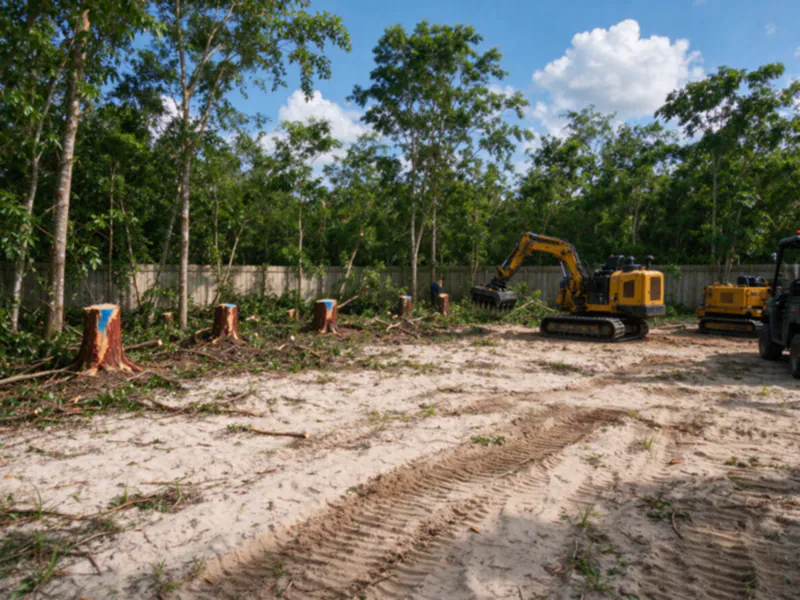
Pulling the root crown. In open ground a machine with a grapple or bucket lifts the base of the plant and its main roots out. That leaves little to resprout, though broken roots can still send up the odd sucker. It suits building areas and yards where a hole can be filled and leveled.
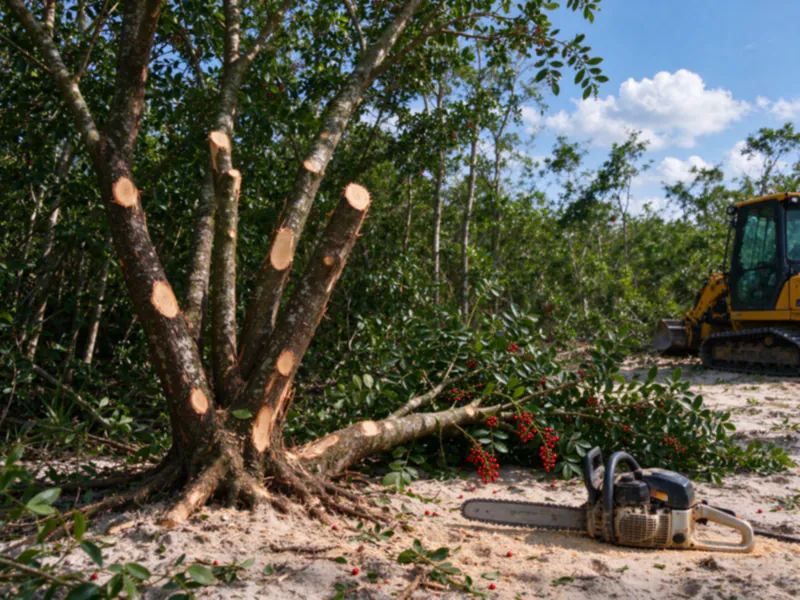
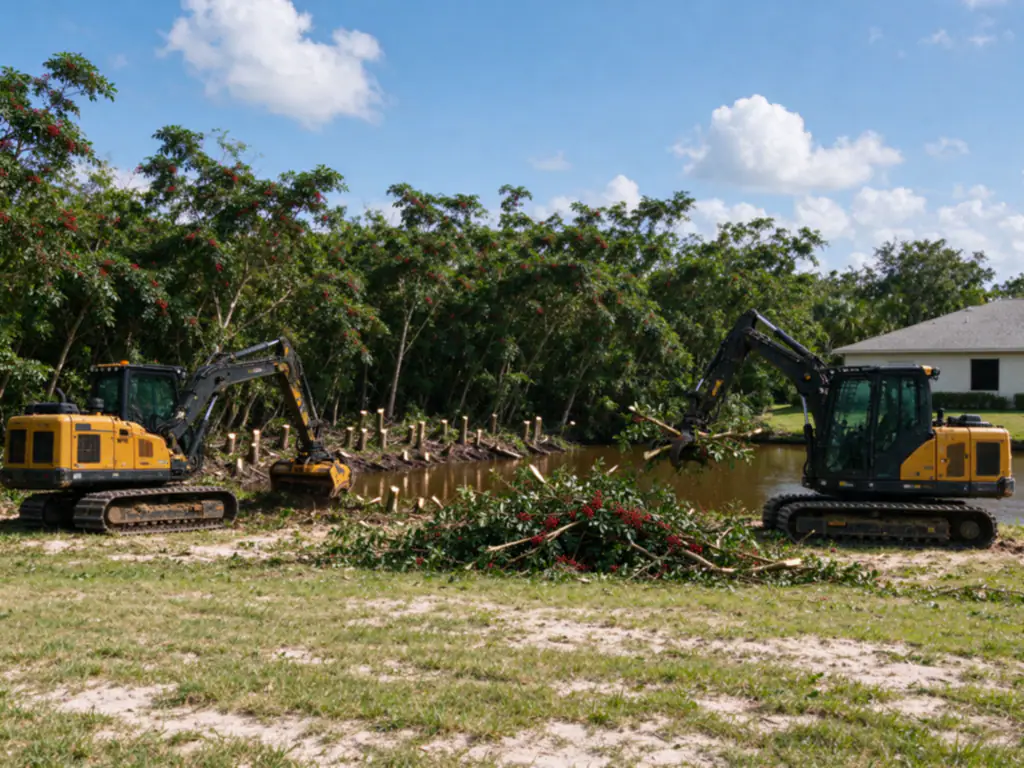
Cut and treat. Along a fence, on a canal bank, near a septic drainfield or a kept tree, digging would do more harm than good. There the stems are cut low and the fresh cut surface is treated with herbicide right away, following the product label and the control guidance UF/IFAS Extension publishes. A marker dye in the mix shows which stumps are done. Homeowners report being told to pour gasoline on pepper stumps; that is dangerous, pollutes the ground and is not a control method.
Cut only is not removal. A pepper cut to the ground and left untreated resprouts quickly and comes back as a denser clump, which is why a cut-only job a few years ago often explains the thicket in front of you now. Homeowners also report landscapers declining to quote pepper thickets with heavy root mass, because it is machine and treatment work rather than yard work.
Debris gets its own plan. Branches carrying berries are loaded and hauled rather than chipped and spread, since the seeds can sprout wherever the chips land. Stems without fruit can be chipped. Burning is rarely an option in Palm Bay neighborhoods, where the state’s 300-foot setback for land clearing piles cannot be met, as the burning debris guide explains. The sap matters too: pepper is related to poison ivy, and cutting it calls for long sleeves, gloves and eye protection.
What it costs and what to watch afterward
There is no published price band for invasive removal on its own. The price moves with the size and density of the thicket, how much can be pulled versus treated, access for a machine, work along water, and the volume of fruiting debris to haul. On a full house lot, pepper is one of the drivers inside the lot clearing cost.
Afterward, watch for root suckers and seedlings for a season or two, and pull them while they are small. Neighboring pepper and birds will keep seeding the edges, so a cleared fence line needs an occasional look, as the after land clearing guide explains. Brush clearing handles the general cut-back around it.
What a Brazilian pepper removal scope includes
- A walk to map the pepper, separate it from native trees and shrubs, and check fences, canal banks and burrows
- A written scope naming which stems are pulled with the root crown and which are cut and treated
- Pepper cut low, starting from the outside of the thicket
- Root crowns lifted out by machine where the ground and access allow
- Cut stumps that stay in the ground treated right after cutting, following the product label
- Fruiting branches loaded and hauled rather than chipped and spread on site
- A hand-off walk with a note on root suckers and seedlings to watch for
Three ways to take out Brazilian pepper
| Cut only | Cut and treat the stump | Pull the root crown | |
|---|---|---|---|
| What stays in the ground | Stump and full root system | Stump and roots, killed by treatment | Little; the crown and main roots come out |
| Regrowth | Fast resprouting from stump and roots | Low when the cut is treated promptly; check for suckers | Low; scattered suckers from broken roots |
| Ground disturbance | None | None | A hole per crown, filled and leveled |
| Best fit | Not a removal method on its own | Fence lines, canal banks, near septic, lawns | Building areas and open ground a machine can reach |
| Meets the CO rule on a lot being developed | No | When the plants are dead and gone | Yes |
Most thickets get both: crowns pulled where the machine can reach and stumps treated along fences, slopes and canal edges.