Last Updated:
Flatwood Land Clearing Palm Bay handles land clearing debris removal across Palm Bay and south Brevard, either as part of a lot clearing or brush clearing job or on its own for wood that is already cut and lying on the ground. A cleared quarter-acre lot of pine flatwoods produces more logs, brush and stumps than most owners expect, and there are only four things to do with it: grind it where it stands, chip it and spread it, load it and haul it away, or burn it. Which one fits depends on what the site will become, how much room there is and what the state and city allow. The work is carried out by licensed and insured contractors, and the debris plan is written into the scope before the first tree comes down.
What happens on the first visit
The visit estimates the volume, which drives the price more than anything else in debris work. Vegetation density, the number and size of the trees and the count of stumps that will be pulled all go into it. It also checks for what does not belong in a wood pile. Vacant lots collect old fencing, buried wire, tires, concrete and dumped household trash, and every piece of it has to be pulled out before the wood goes through a chipper or onto a truck.
The walk looks at where a truck can stand and turn without crushing the swale or the culvert at the driveway, and whether a canal easement runs along the back line. It checks for gopher tortoise burrows, because staging a pile or running a loaded machine within 25 feet of one needs an FWC permit too. And it settles the question that changes everything else: how much of the material can stay on the property.
Mulch it, chip it, haul it or burn it
Mulching in place
A forestry mulcher grinds standing brush and small trees into a layer on the ground surface, so there is almost nothing to haul. It is the cheapest disposal there is, and it is the right finish for a lot being held, a trail, a firebreak or a wooded edge. It is the wrong finish anywhere something will be built, because the stumps and roots stay in the ground and the mulch layer is organic material that has to come out before fill.
Chipping and spreading
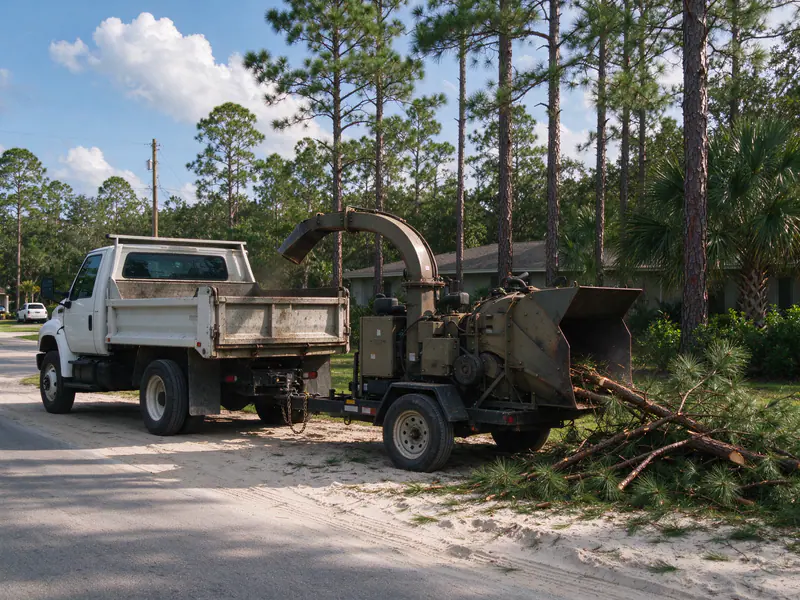
Limbs and brush cut during clearing can be fed through a chipper and the chips spread on yard areas, along the lot line or in planting beds. Chipping cuts the volume of brush sharply, and chips kept on site are loads that never reach a disposal gate. Chips stay off the house pad and driveway for the same reason mulch does, and a thick layer against the trunk of a kept tree is a poor idea too.
Loading and hauling
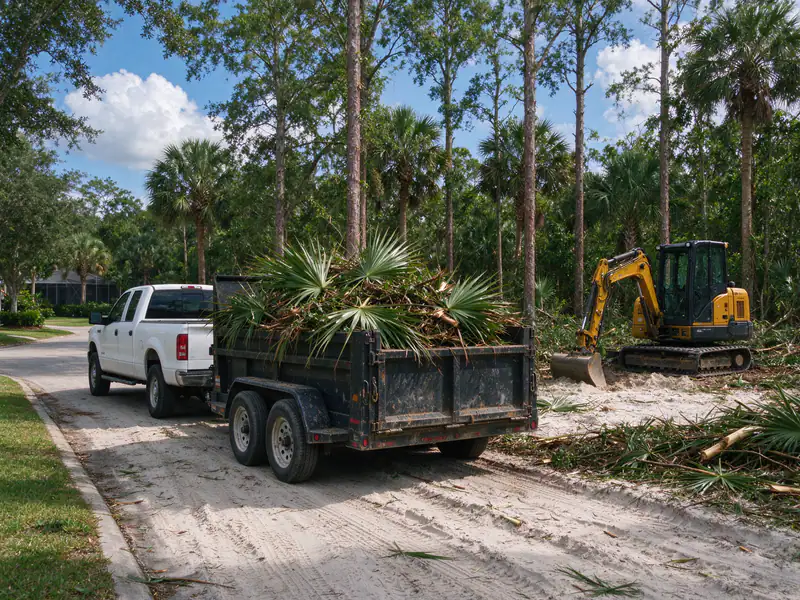
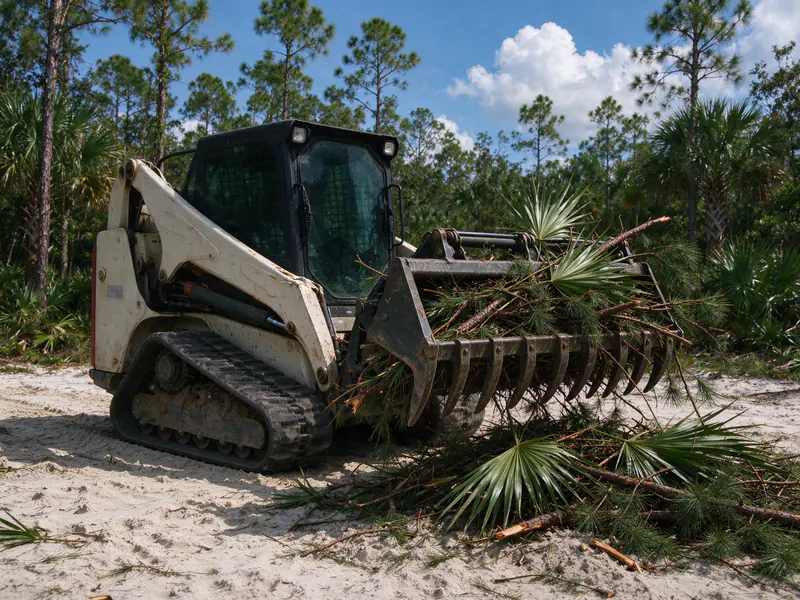
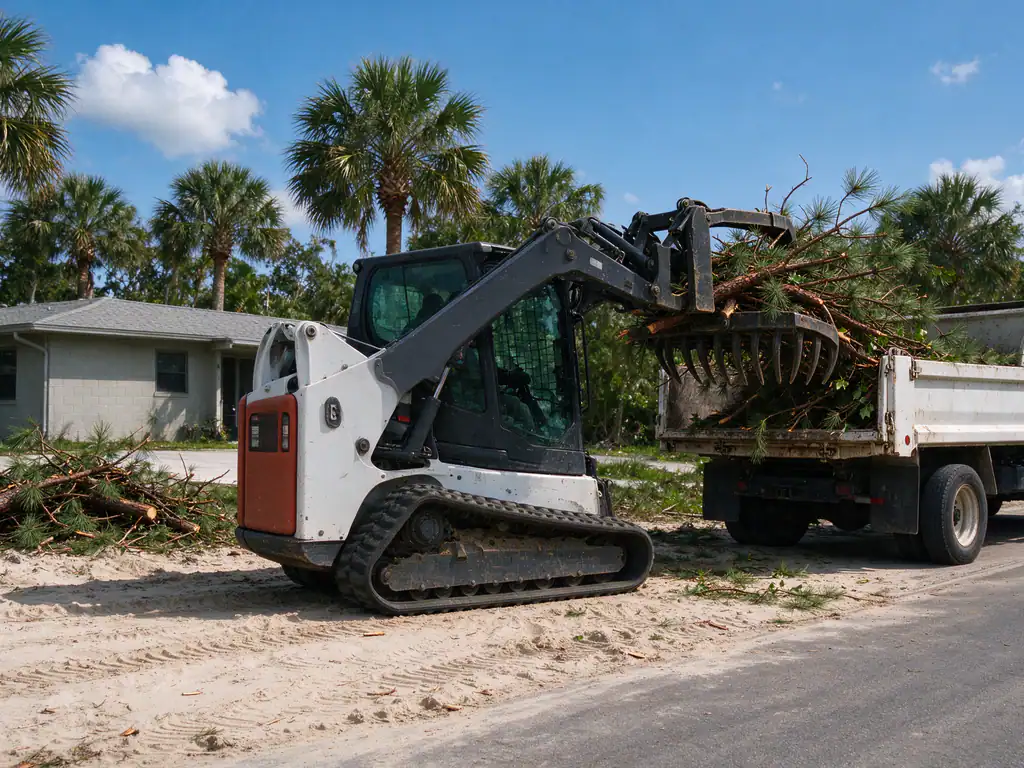
On most Palm Bay house lots, a share of the debris has to leave. Logs, stumps and whatever cannot be chipped are sorted by a grapple and loaded into a dump truck or trailer, and the load goes to a disposal or mulching facility that accepts land clearing debris, per the county’s posted gate rates. Two numbers set the cost: how many loads there are and how far each one travels, since a truck on the road to a distant gate is time spent whether it is full or on its way back. Sebastian and the Roseland section across the county line fall under Indian River County’s disposal sites and rates instead. How the debris line fits into a full clearing price is in the Palm Bay lot clearing cost guide.
Melbourne adds a rule worth knowing. The city says yard waste produced by landscape contractors or tree removal workers is the contractor’s to dispose of, not the sanitation hauler’s, and that yard waste cannot be placed on vacant lots, streets, medians or parks. In Melbourne, haul-off is part of the job from the first quote, as the Melbourne page explains.
Burning
Burning sounds cheapest and is usually unavailable. Under Florida Forest Service rule 5I-2.006, burning a land clearing pile needs an authorization and keeps the pile at least 300 feet from any occupied building, 50 feet from brush, woods and combustible structures, and 100 feet from a paved public road, and the fire has to be out an hour before sunset. Tree debris from a home of one or two units can be burned only on the property it came from. An air curtain incinerator, a blower and pit that burns hotter and cleaner, needs a state air permit or exemption and the same 300 feet from occupied buildings.
Palm Bay’s vacant platted lots average about 0.27 acre, with houses on either side or soon to be, so the 300-foot setback rules almost all of them out. The homeowner’s yard-waste allowance does not stretch to cover a clearing job either: it is for piles that fit an 8-foot circle, kept 25 feet from the house, 50 feet from a paved road and 150 feet from other occupied buildings. On top of that, Palm Bay’s fire chief has banned open burning when Brevard’s drought index reached 500, as the burn ban season post explains, and Titusville prohibits land clearing burns outside special permits for large-scale clearing. Burning is a real option only on large acreage, and the burning land clearing debris guide covers when it works.
Not sure what can stay and what has to go?
Send a few phone photos of the lot or the pile and say what the land will be used for. The debris plan starts from there.
Stumps, sand and mixed loads
Stumps are the heaviest and slowest part of any debris job. A pulled stump comes out of Palm Bay sand with a root ball full of it, and that sand adds weight to every load and wears down chipper knives and grinder teeth. Shaking stumps hard before loading, or grinding them in the ground where they do not need to come out, keeps that cost down. The clearing and grubbing page explains when stumps have to be pulled and when grinding them is enough.
Mixed loads cost more. Disposal sites price clean vegetation separately from construction and demolition waste, and a load of brush with fencing, roofing or concrete mixed in can be charged as the more expensive kind. Sorting the trash out on site, and hauling it as its own small load, keeps the wood load clean.
Timber does not usually pay for the haul
Homeowners often hope a few good pines will offset the debris cost. In south Brevard that is rarely realistic. UF/IFAS reports that statewide pine stumpage prices are low and that markets for some products are simply not present in some areas, and no local timber market for small residential lots has been confirmed. The scope treats the logs as debris unless a buyer is lined up first.
Keep it out of the swale and the canal
Palm Bay’s city GIS maps roughly 395 miles of drainage canal lines, much of it in rights-of-way held by the Melbourne-Tillman Water Control District, the city or the St. Johns River Water Management District. Clearing stops at the easement line, and nothing is pushed into a canal or onto its bank, where it would block drainage for the whole street. The same goes for the swale in front of the lot. Wood that sits in a swale through a summer storm ends up in a culvert.
Debris already on the ground
Some jobs are only debris: a lot cleared by someone else and left in windrows, a pile from a tree removal, or limbs and trunks brought down by a storm. Those are loaded, chipped or hauled the same way, and fallen and storm-damaged trees have their own considerations on the storm debris cleanup page. What a finished site needs after the wood is gone is in what to do after land clearing.
What a debris hauling scope includes
- A volume estimate from the vegetation density, tree sizes and stump count
- A check for wire, concrete, tires and dumped trash that must be kept out of the wood
- A written plan for each kind of material: chip, mulch in place, haul or, where allowed, burn
- Grapple sorting of logs, brush and stumps into separate loads
- Chipping of limbs and brush, with chips spread where the finish allows
- Loading and haul-off to a site that accepts land clearing debris
- Non-vegetative trash separated and hauled as its own load
- The swale, street and any canal easement left clear of debris
- A final rake of the cleared area
Four ways to deal with land clearing debris
| Mulch in place | Chip and spread | Load and haul | Burn | |
|---|---|---|---|---|
| What happens | A forestry mulcher grinds standing brush and small trees into the ground surface | Limbs and brush go through a chipper and the chips are spread | Logs, brush and stumps are loaded and trucked to a disposal or mulching site | Piles are burned on site under state authorization |
| Works under a house pad | No: organic layer left behind | No: chips belong on yards and edges | Yes | Yes, once ash and stumps are cleared |
| Handles stumps | Ground near grade, roots left | No | Yes | Partly; large stumps burn slowly |
| What sets the cost | Machine hours and density | Volume and how far chips are moved | Number of loads, haul distance and gate fees | Authorization, fire watch and setbacks |
| Usual fit | Lots being held, edges, trails | Yard areas and lot edges | Most Palm Bay house lots | Large acreage only |
Most jobs mix methods: chips at the edges, hauled stumps and logs, and no burning on a subdivided lot.