Last Updated:
Flatwood Land Clearing Palm Bay provides commercial land clearing in Palm Bay and across south Brevard for builders, developers and owners of multifamily, retail, office, industrial and institutional sites. The job is the same in kind as clearing a house lot: trees down, brush off, stumps and roots out where something will be built. What changes is the paperwork that governs it. A commercial site is cleared to an approved site plan, a tree survey and an erosion control plan, and often under state stormwater and environmental permits, so the limits, the kept trees and the order of work are set before a machine arrives. The work is carried out by licensed and insured contractors, from a written scope tied to the plan sheets.
What happens before the first visit
Commercial clearing starts at a desk. The approved site plan shows the limits of clearing, the building and paving footprints, the stormwater pond, the buffers and the trees to be kept. The tree survey shows every tree’s size and species and which ones are coming out. The erosion control plan, and on a site of an acre or more the stormwater pollution prevention plan, shows where silt fence, inlet protection and the construction entrance go and in what order.
The site walk then checks the paper against the ground: whether the limits are staked, whether the kept trees on the survey are the trees standing there, where wet ground and standing water are, whether gopher tortoise burrows have been surveyed and handled, where overhead and buried utilities run, and how loaded trucks will get in and out without tracking sand onto the road. Anything that does not match goes back to the engineer before clearing, not after.
Palm Bay’s site work permit
Inside Palm Bay, clearing, scraping, balancing or filling land on anything other than a one- or two-family site under an acre needs a Site Work Permit under §175.016 of the city’s tree code. The permit also authorizes the tree and underbrush removal shown on the approved site plan, which is why sites holding a recently approved site plan and a valid site work permit are exempt from the separate tree removal and grubbing permits. The application needs:
- the fee, paid during site plan review, per the city’s current fee schedule;
- the recorded deed;
- documentation that every external agency permit the project needs has been obtained;
- a city-stamped approved site plan;
- a full environmental assessment covering the site’s habitats, soils, vegetation, species and surface waters, including whether it lies in the protected Turkey Creek or Indian River Lagoon watersheds;
- a tree survey at a scale no smaller than one inch to 50 feet, with every tree’s diameter and names on sites up to ten acres, and the protected and specimen trees on larger sites.
A pre-sitework meeting follows site plan approval and comes before the permit, and the permit is not issued until building permits have been applied for and all site plan review is complete. The Palm Bay permit guide covers the residential side of the same chapter.
Replacement trees and credits
The tree code charges for what comes out and credits what stays. Each protected tree of 6 to under 12 inches approved for removal needs one replacement tree on the landscape plan, and each specimen tree of 12 inches or more needs one restoration tree for every 6 inches of its diameter, both native canopy species of a set minimum size. Trees not planted are paid as mitigation fees. Kept trees earn credit toward the landscaping requirement, groups of four or more trees can be credited by their summed diameter, and palms can make up no more than 30 percent of the credited trees. Preserved vegetation can also be offered in support of administrative variances for parking reductions, density or building size. Keeping a stand of pines in a buffer is often worth more than the clearing it saves, and selective clearing is how it is done.
Clearing outside the permit brings a stop-work order, a late application at double the fee, a restoration plan and a held certificate of occupancy. Site work without an approved drainage plan is also a violation of the city’s stormwater ordinance.
State stormwater and environmental permits
Two state programs sit above the city’s permit. Florida DEP’s construction generic permit covers construction that disturbs one acre or more, or less if the site is part of a larger common plan of development or sale; coverage comes through a notice of intent, and the stormwater pollution prevention plan has to be prepared before that notice is filed. The St. Johns River Water Management District handles Environmental Resource Permits in Brevard, which Rule 62-330.020 requires for any work in, on or over wetlands or other surface waters, for a total project area over five acres, and for impervious area above the rule’s thresholds. Clearing near wetlands covers the wetland side.
Neighboring cities add their own steps. West Melbourne requires a city building permit before any site work, including clearing or silt fence staking, and a pre-construction meeting once disturbance reaches half an acre. Melbourne reviews erosion and sediment control through a land alteration permit, and Rockledge site plans need two sealed tree surveys and an erosion and sedimentation control permit application. The Melbourne and Rockledge pages cover those cities.
Have a site plan ready to price?
Send the plan sheets and tree survey. The scope is written against them, area by area.
Protected species on commercial sites
Palm Bay holds a citywide federal incidental take permit for the Florida scrub-jay, issued in 2007, under which land clearing can be restricted during nesting season where active nests are on or near the site; the exact window is set with the city. Commercial projects that convert occupied scrub-jay habitat outside that framework go through their own federal habitat conservation plans, and recent Brevard examples recorded by the U.S. Fish and Wildlife Service mitigated with conservation bank credits or contributions to the Florida Scrub-jay Conservation Fund. The scrub-jay guide explains how to tell whether a parcel is affected.
The order of work on a cleared commercial site
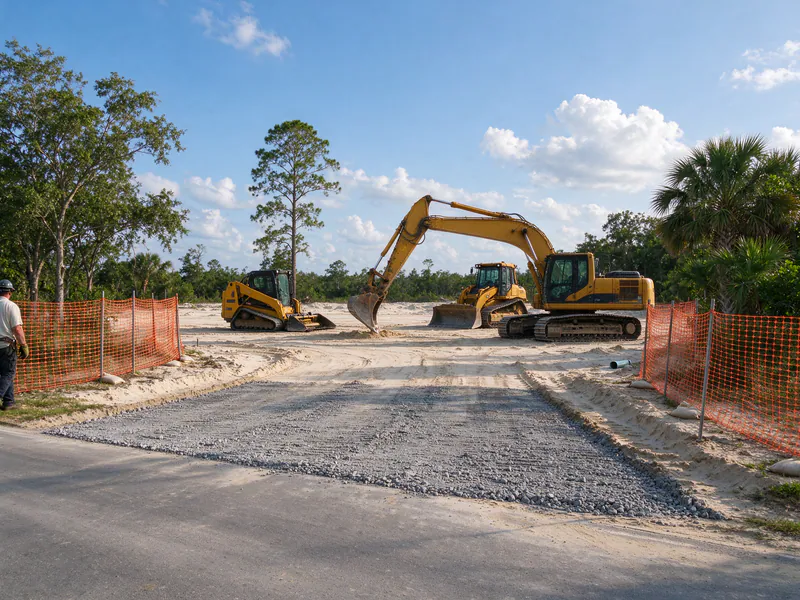
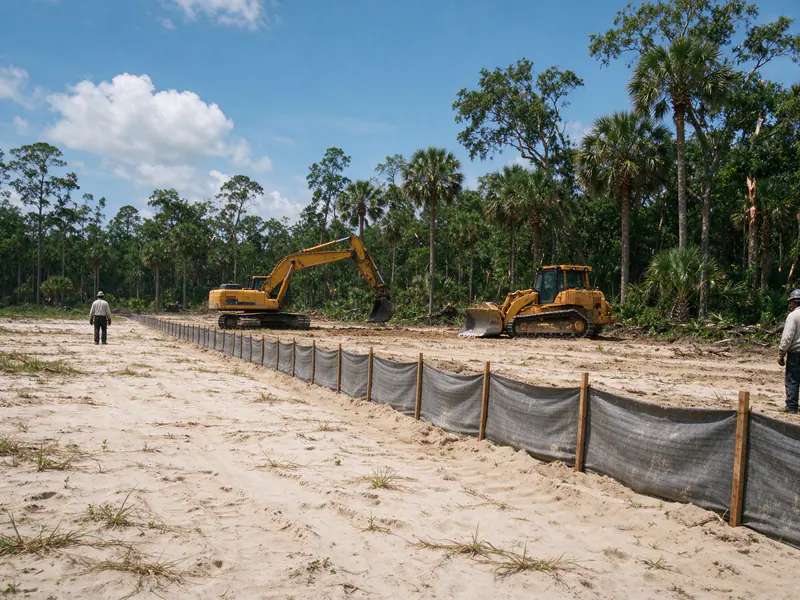
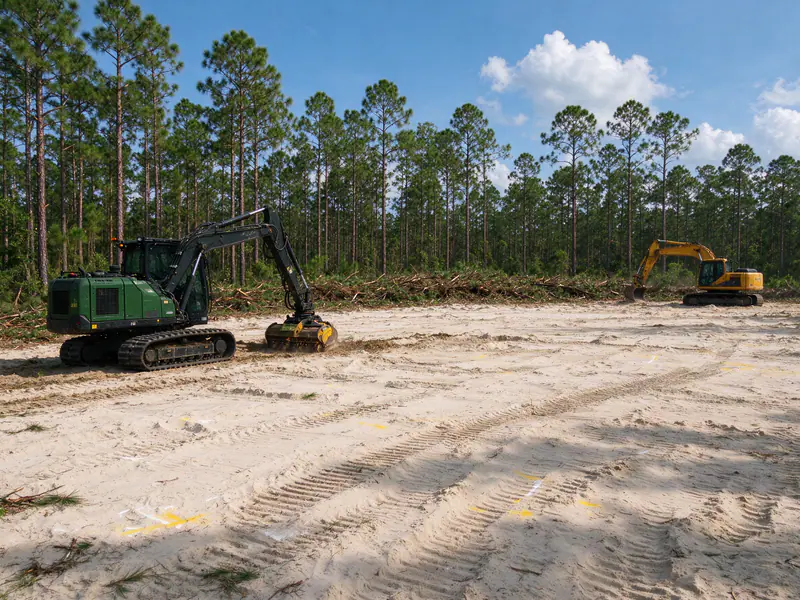
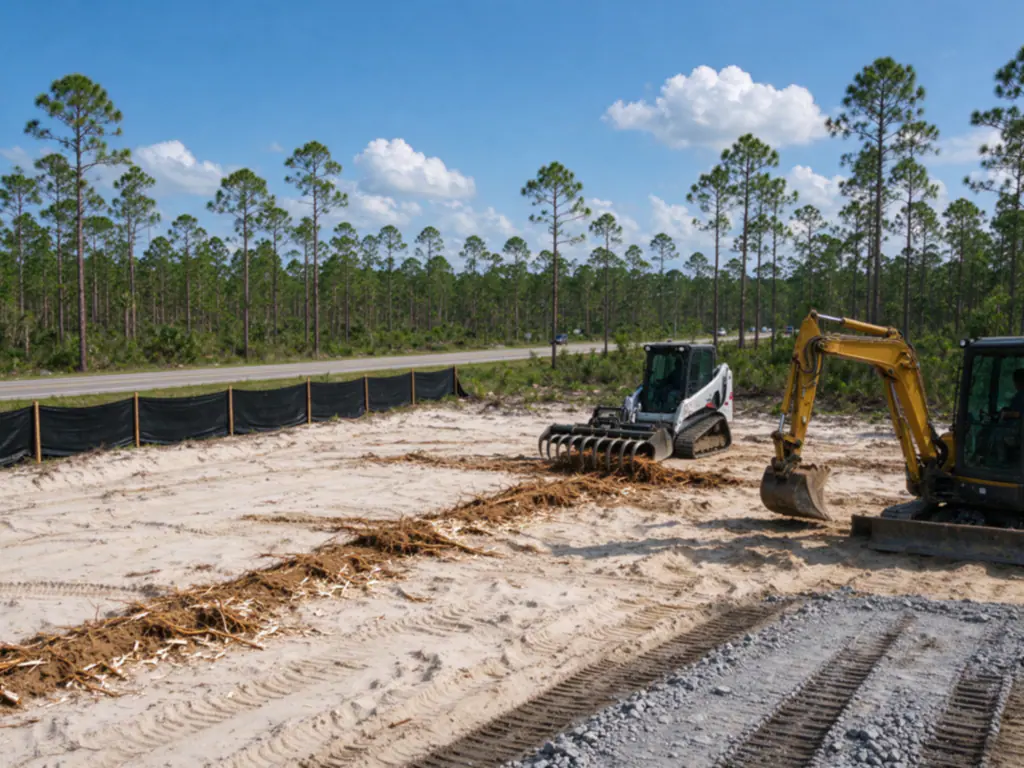
Erosion controls go in first: silt fence along the downslope limits, inlet protection and a stabilized construction entrance where trucks will leave. Then the tree barricades are set to the plan’s protection details, at the critical root zone or 10 feet from the trunk, whichever is greater. Clearing follows inside the staked limits, with felling planned away from roads, power lines and neighboring buildings. The building, paving and pond footprints are then grubbed, as on the clearing and grubbing page, and the organic surface layer is stripped and stockpiled or hauled as the plan says.
Two kinds of clearing come up on many commercial plans. Pond site clearing opens the footprint of a stormwater pond and its maintenance berm; digging the pond is earthwork and belongs to the excavation contractor. Road and access clearing opens a private drive, haul road or utility corridor through the site to its planned width. Public roadway contracts are a separate procurement and not part of this work.
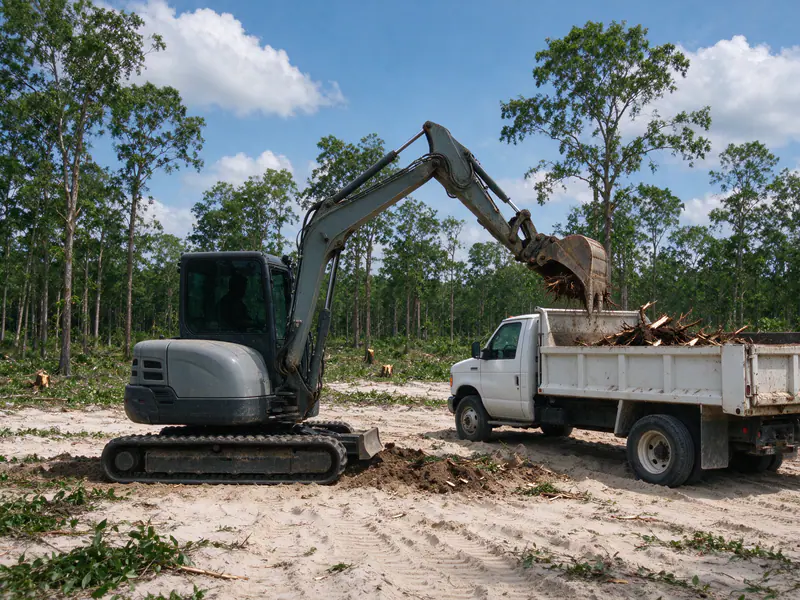
Debris on a commercial site is mostly hauled or chipped. Burning a non-residential pile without an air curtain incinerator requires 1,000 feet from occupied buildings, which few parcels near Palm Bay’s neighborhoods can meet; the debris hauling page sets out the alternatives.
Bare sand left after clearing is the most erodible condition a site will ever be in, and about 55 percent of the year’s rain falls from June through September, per NOAA’s Melbourne normals. Erosion control after land clearing covers how a cleared site is held until the site contractor takes it over.
What a commercial land clearing scope includes
- A review of the approved site plan, tree survey, protection details and erosion control plan
- A walk of the site to confirm limits, kept trees, burrows, wet ground, utilities and access
- A written scope tied to the plan sheets, with clearing and grubbing limits by area
- Coordination of erosion controls and the construction entrance before clearing starts
- Tree protection barricades set to the plan before machine work
- Clearing inside the staked limits, with felling planned away from roads and neighbors
- Grubbing of building, paving and pond footprints where the plan calls for it
- Debris chipped, mulched in buffers, hauled or burned only where setbacks allow
- A hand-off walk with the site contractor against the limits of clearing
The permit layers on a commercial clearing job
| Palm Bay site work permit | State construction stormwater (NPDES) | State Environmental Resource Permit | |
|---|---|---|---|
| What triggers it | Clearing, scraping, balancing or filling on anything other than a one- or two-family site under an acre | Disturbing one acre or more, or less if part of a larger common plan | Wetland or surface water work, more than 5 acres, or impervious area above the rule's thresholds |
| Who issues it | City of Palm Bay | Florida DEP | St. Johns River Water Management District in Brevard |
| What it needs | Approved site plan, tree survey, environmental assessment, external permits, pre-sitework meeting | A SWPPP prepared before the notice of intent | Engineered stormwater design and wetland review |
| What it changes on the ground | Clearing limits, kept trees, replacement trees | Silt fence, inlet protection, stabilized entrance, inspections | Wetland buffers and where clearing may not go |
Clearing is usually the first land disturbance on a site, so every permit that applies has to be in hand before it starts.