Residential platted lot
Lot clearing
A platted lot opened to the site plan: trees and palmetto out where the house, driveway and septic go, marked keepers protected, and stumps handled to the finish the builder needs.

Range plate · Melbourne, Brevard County
Melbourne is mostly built out, so its clearing jobs are infill lots, undeveloped parcels and backyard work at existing homes. On undeveloped land the city's tree fee is counted per inch of trunk, which turns the tree survey into the main budgeting document.
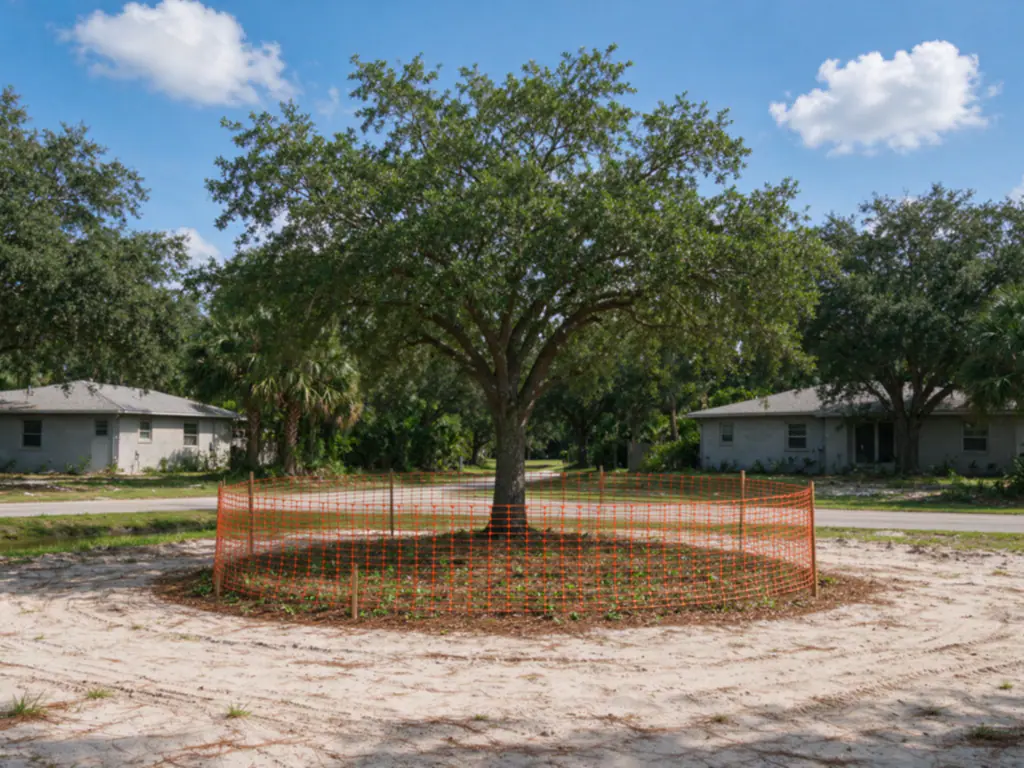 Plate. A Melbourne home site, Brevard County
Legend What changes a clearing job in Melbourne
Key to the parcel
Development of undeveloped land needs a certified tree survey and a site plan, and the trees removed are charged by trunk diameter. The survey comes before the quote.
see Selective clearingClearing a narrow lot next to occupied homes means cutting toward open ground, hauling the debris and keeping the trees the plan counts on.
see Lot clearingMelbourne treats underbrush clearing as its own permitted activity, charged by acreage, so even a brush-only job on undeveloped land goes through the city.
see Brush clearingExisting one-, two- and three-family homes are exempt from the city's tree removal permit, and what is left is often a stump to grind below the lawn.
see Stump grindingServices
Residential platted lot
A platted lot opened to the site plan: trees and palmetto out where the house, driveway and septic go, marked keepers protected, and stumps handled to the finish the builder needs.
Pinus elliottii, Sabal palmetto
Unwanted growth out and the keepers flagged and fenced at the root zone the city sizes from trunk diameter, so the trees you save still count on the landscape plan.
Understory and vines
Underbrush, vines and saplings cut or mulched to ground level, under the trees you keep, with a straight answer about what grows back and how fast.
Below-grade grind
Stumps ground below grade where lawn, driveway or path will go. The grindings refill the hole or are hauled away, and the roots past the grind decay slowly in the sand.
Logs, slash and stumps
Clearing debris chipped and spread, mulched in place, or loaded and hauled to a permitted site. Which one fits depends on the finish and on whether burning is allowed at all.
Site plan and site work permit
Clearing to an approved site plan, with the site work permit, tree survey and erosion controls in place first. Disturbing an acre or more also needs state stormwater permit coverage.
Field procedure
The address, whether the property is an existing home or undeveloped land, and what is planned. That decides which city permits apply.
Trees to keep are marked, and the visit checks for gopher tortoise burrows, wet ground and how machines and trucks reach the work next to neighbors.
The scope lists the trees by diameter, the underbrush area, the stump plan, where the debris goes and which city permits the job needs.
With permits issued, keepers are barricaded and the work is done; the hand-off walk checks the site against the scope, debris included.
Last Updated:
In Melbourne the price of taking trees off undeveloped land starts with a tape measure, because the city charges its tree removal fee by the inch of trunk. That is why the tree survey is the first document Flatwood Land Clearing Palm Bay asks for when it plans clearing on a Melbourne infill lot, undeveloped parcel or yard, and the scope then follows the city’s underbrush and debris rules, with licensed and insured contractors doing the work.
Melbourne authorized 221 new single-family homes for 2020 and 48 for 2025, by the Census Bureau’s count, so new-home clearing here is mostly scattered infill rather than whole subdivisions. That changes how a job looks on the ground. An infill lot usually has occupied houses on two or three sides, so trees are felled toward open ground, the debris leaves by truck and the trees along the property lines are often the ones worth keeping. Lot clearing on a parcel like this is a smaller footprint with more care at the edges than a wooded lot on an empty street.
The City of Melbourne’s Engineering Department charges for tree removal on undeveloped property by diameter at breast height. Its fee page lists a $100 application plus $100 per inch, or per palm, on developments under an acre, rising to $125 per inch from one to five acres and $150 per inch above five acres. Grand trees are $300 per inch, and a buy-out in lieu of replacement is listed at $275 per tree for the city’s Native Tree Replacement Fund. The application lists trees from 4 inches in diameter and palms with 6 feet or more of clear trunk. As an illustration only, three 10-inch pines removed on a sub-acre development would add 30 inches, or $3,000 at the listed rate, before the application fee. So the survey that maps each tree’s diameter is also the budget, and selective clearing that keeps one or two large trees can lower the permit cost more than trimming the cleared area. The city confirms its current fees when the application is filed.
Melbourne treats clearing underbrush on undeveloped land as a separate permitted activity, even when no tree is removed. The fee page lists a $100 application plus $50 for developments under an acre, $75 per acre from one to five acres and $100 per acre above five, and a Land Alteration Permit review for erosion and sedimentation control at $188. For a buyer who only wants a parcel opened up for a survey or a look at the ground, that means a brush-only job still starts with the city. Brush clearing with a mulching head leaves the roots holding the sand, and the mulching versus bush hogging guide compares the two finishes.
The city’s tree removal application exempts existing one-, two- and three-family dwellings, which puts a homeowner’s backyard job in a different category from an undeveloped parcel. A dead pine near the house, an oak lifting the driveway or a stand of overgrown brush along the back fence can be scoped without the per-inch fee, though deed restrictions or an association may still have a say. Many of those jobs end with a stump to grind, and stump grinding takes it below the lawn so grass or sod can go back over it. The stump grinding cost guide explains what moves that price.
About 14 percent of Melbourne’s mapped soil is well to excessively drained, against about 3 percent inside Palm Bay, because parts of the city sit on the coastal ridge where sand pine and scrub oak grow. Brevard County’s map shows 15 historical scrub-jay survey polygons reaching into the city, with 31 families counted in 1993 and 23 in 2000 to 2002. The birds are not only history here. A federal habitat conservation plan published for a taxiway project at Melbourne Orlando International Airport covered about 1.75 acres of occupied scrub-jay habitat, with a $100,380 contribution to the Florida Scrub-jay Conservation Fund. An undeveloped parcel with scrub on it is screened before clearing, as the scrub-jay guide explains.
The city’s Public Works pages are plain on this point: yard waste produced by landscape contractors or tree removal workers is the contractor’s to dispose of, not the sanitation hauler’s, and it may not be left on vacant lots, streets, medians or parks. So every Melbourne clearing quote includes the debris plan, whether that is chipping and spreading on site, mulching in place or loading for debris hauling. On a parcel heading for a site plan, bare sand also needs cover once the clearing is done, and the erosion control guide covers the options.
Method
Where the city charges per inch of trunk, saving one large tree can change the permit cost more than shrinking the cleared area. The survey shows which trees carry the cost.
The city leaves contractor yard waste to the contractor, and it cannot be set on a vacant lot or street. Debris is planned into the scope from the start.
Range
City of Melbourne Engineering Department (321-608-7300) for tree removal and underbrush clearing permits; the Building Division for building permits.
Notes
On development of undeveloped property, yes. The City of Melbourne's fee page lists a $100 application plus $100 per inch of trunk diameter, or per palm, on developments under an acre, $125 per inch from one to five acres and $150 per inch over five acres, with grand trees at $300 per inch. Fees are confirmed with the city's Engineering Department when the permit is filed.
On undeveloped land, Melbourne treats underbrush clearing as its own permit. The city's Engineering fees list an application of $100 plus $50 for developments under an acre, $75 per acre from one to five acres and $100 per acre over five, and a separate erosion and sedimentation control review. Whether a given parcel needs it is confirmed per address.
Melbourne's tree removal application exempts existing one-, two- and three-family dwellings, so a homeowner taking a tree out of a built lot is outside the per-inch fee. Other limits can still apply, such as deed restrictions or a homeowners association, and those are confirmed per address before the work is scheduled.
National budgeting ranges put the first stump at about $120 to $400 and each additional stump at about $30 to $60, or about $2 to $6 per inch of diameter. Small jobs often carry a minimum of about $80 to $160. Stump size, roots near a slab or driveway and access through a fenced yard move the price within that range.
No. The City of Melbourne states that yard waste generated by landscape contractors or tree removal workers must be disposed of by the contractor, and that yard waste may not be placed on vacant lots, streets, medians or parks. A clearing scope there includes chipping, mulching or hauling the material away.
Neighboring range
Estimate
Get an estimate for clearing in Melbourne
Send the address, whether it is an existing home or undeveloped land, and which trees you hope to keep. A tree survey helps if you have one.
(321) 513-1820Outside these hours, emergency calls only.