Last Updated:
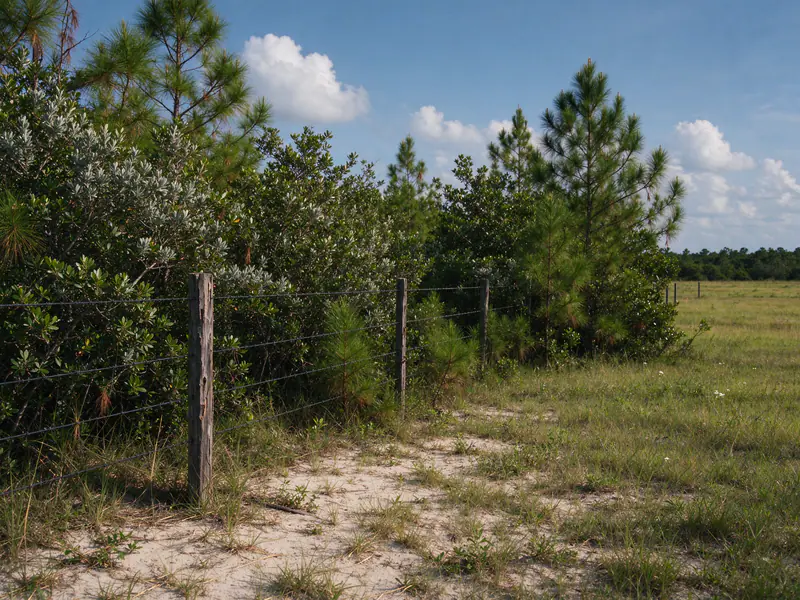
Flatwood Land Clearing Palm Bay offers pasture clearing on acreage in Palm Bay, Malabar, Grant-Valkaria and the rest of south Brevard: fields that have been taken over by saw palmetto, Brazilian pepper and young pines are pushed back to open ground, and the fence lines around them are cleared. Left alone, a Florida flatwoods pasture does not stay a pasture. Palmetto creeps in from the edges, pepper fills the fence rows and pines seed into the open ground, and given enough seasons the field reads as woods again. The work is carried out by licensed and insured contractors, from a written scope that matches the finish to how the land will be used.
Where the acreage is
Most of Palm Bay is platted quarter-acre lots, so pasture work sits mainly on its western edge and in the towns to the east and south. County parcel data shows 50 vacant grazing parcels inside Palm Bay averaging about 98 acres, plus 11 vacant acreage parcels of five acres or more averaging about 139 acres. Malabar’s 1,170 homes sit on lots averaging 1.64 acres, with 583 vacant unplatted residential parcels averaging 1.45 acres. Grant-Valkaria has 2,557 homes averaging 1.45 acres and 2,657 vacant unplatted residential parcels averaging 1.38 acres, about 3,677 acres in all.
That gives two very different jobs. One is the one- to five-acre parcel with a field behind the house that has grown in. The other is a large grazing tract where clearing is measured in tens of acres. Both use the same methods; they differ in machine size, debris options and the rules that apply. The Malabar and Grant-Valkaria pages cover the local side of acreage work.
What happens on the first visit
The first question is what the field is for. Grazing pasture that will be kept by mowing, hay ground or planted pasture that will be disked, a garden or arena area, or just open ground that is easier to keep: each one calls for a different finish, and the cheapest method that gives the right finish is the one to pick.
The walk then covers the field itself. It marks the shade trees and windbreaks worth keeping, finds the wet ground and any wetland edge, looks for gopher tortoise burrows in the drier sandy rises, and follows every fence line looking for old wire, posts and gates hidden in the brush. Ground conditions matter on acreage too. About three-quarters of Grant-Valkaria’s mapped soils are poorly or very poorly drained, and about two-thirds of Malabar’s, per the USDA soil survey, so a field that is firm in April can rut badly in August.
Matching the method to how the field will be used
Mowing for fields that are still open
If the field is still mostly grass with brush starting at the edges, a heavy mower or bush hog cutting it back may be all it needs. It is the cheapest option and it does nothing below the cut, so it is maintenance rather than reclamation. The forestry mulching vs bush hogging guide compares the two machines.
Forestry mulching for grazing pasture
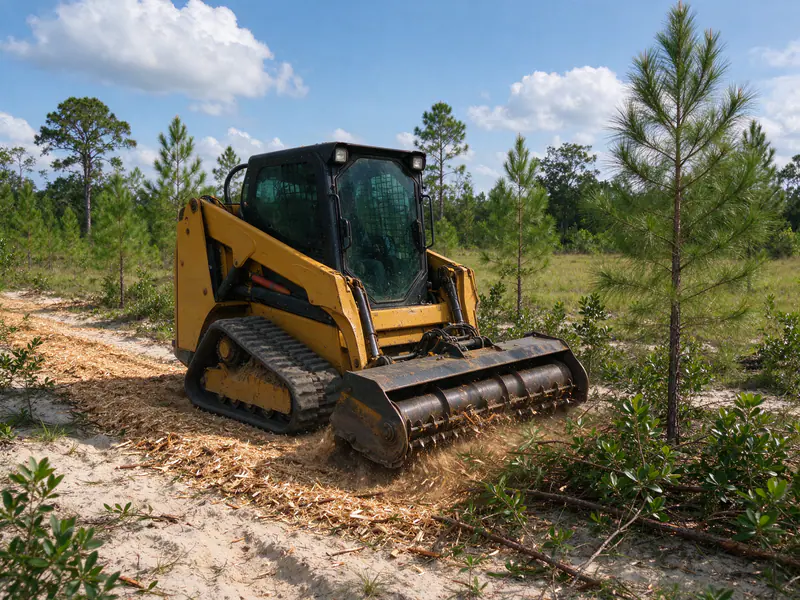
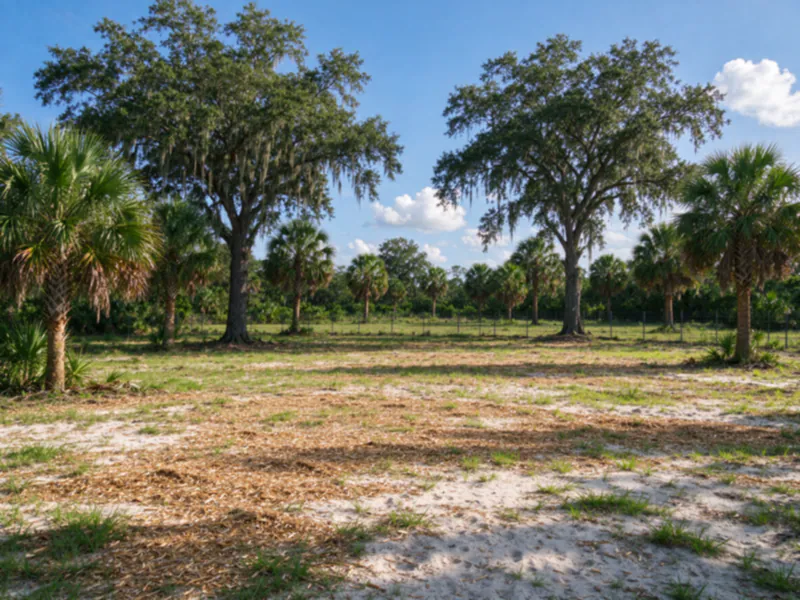
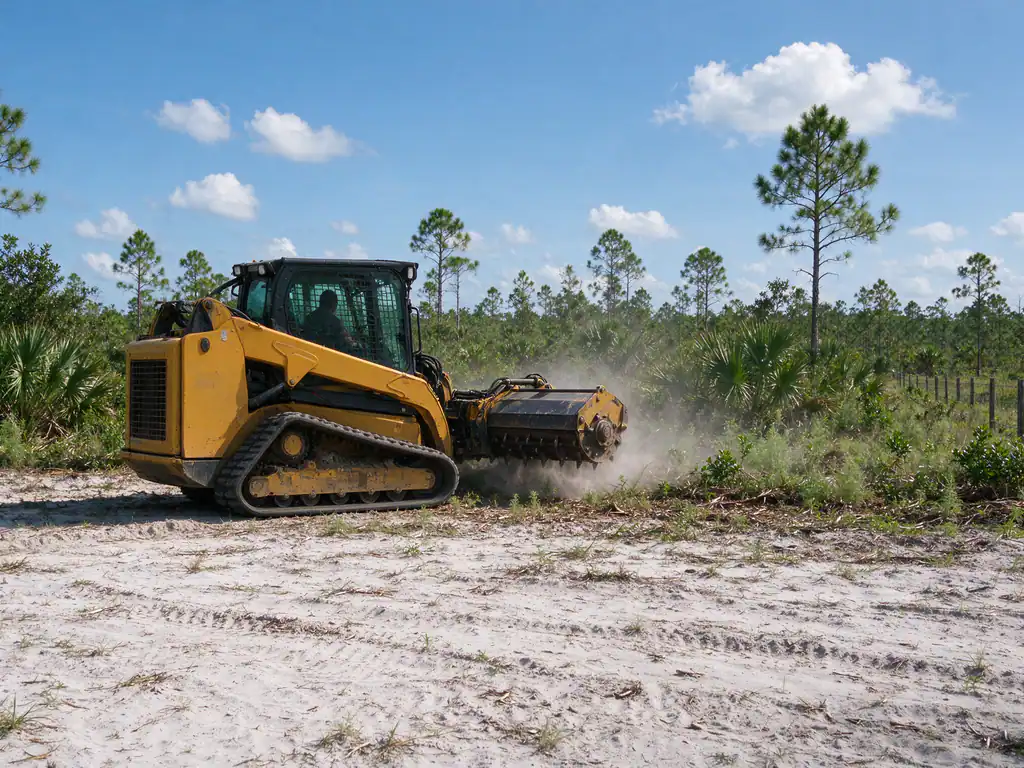
Where palmetto and small trees have filled in, a forestry mulcher grinds them into a layer on the ground. The field becomes mowable, the mulch holds the sand in summer rain, and nothing has to be hauled. What it does not do is remove roots. Stumps are left near grade and saw palmetto trunks stay in the sand, where they resprout unless the field is mowed regularly afterward.
Root raking for fields that will be planted
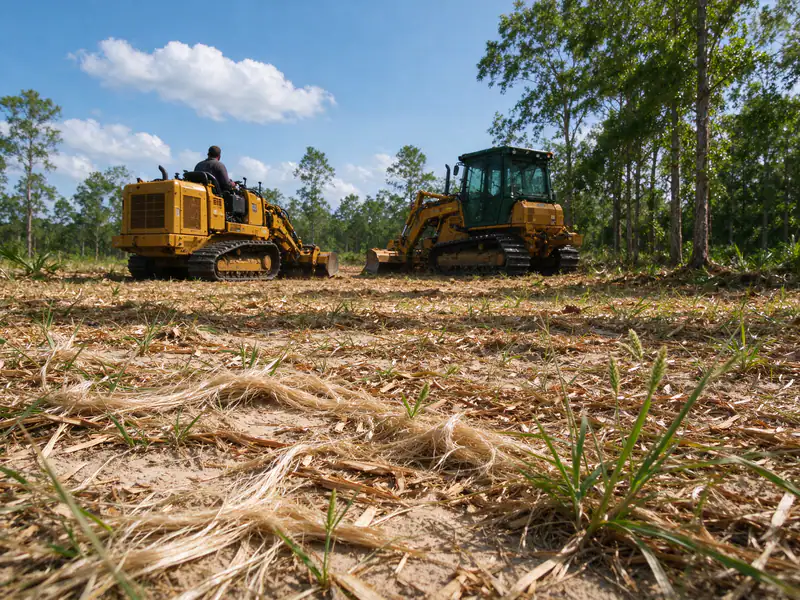
If the field will be disked and planted, mulching alone is the wrong finish. Homeowners report fields that were forestry-mulched years earlier still fouling a plow on small stumps and palmetto roots. For planting, the stumps are pulled and a root rake combs the trunks and roots out of the top of the sand, the same work described on the clearing and grubbing page. It costs more and leaves bare sand, so it is usually kept to the area that will actually be planted.
Brazilian pepper, wherever it is, comes out with its root crown. It is on Florida’s noxious weed list and resprouts hard from a cut stump, which is why Brazilian pepper removal is its own job.
Not sure which finish your field needs?
Send a few phone photos of the field and the fence lines, the rough acreage and how you plan to use it.
Fence lines
Fence rows are where pasture brush is thickest, because a mower cannot reach under the wire. Clearing them is slow, close work. The line is walked first to find the wire: barbed wire grows into tree trunks and lies hidden under palmetto, and a strand caught in a mulcher head or chipper drum stops the machine and can damage it. Found wire is pulled by hand where it can be and hauled as trash, separate from the wood.
The cleared width is set on the walk, wide enough for the fence work and for a mower to keep the strip open afterward. Clearing stays on the owner’s side of the property line unless the neighbor agrees to more. Building or repairing the fence itself is a separate trade and not part of this work.
Agricultural exemptions vary by jurisdiction
Agricultural land gets lighter treatment in local tree codes, but how much lighter depends on where it is and what it is used for. Palm Bay’s code exempts bona fide agricultural uses, cultivation and grazing lands from its tree removal permit, its grubbing permit and its site work permit. Malabar runs its own land clearing and tree ordinance, which requires mitigation for vegetation loss and prompt cover of exposed soil, and Grant-Valkaria and unincorporated Brevard rules are confirmed per address.
No local exemption reaches the state and federal rules. Any work in a wetland or other surface water needs a state Environmental Resource Permit, as clearing near wetlands explains, and Malabar’s regulations require a wetland buffer of at least 25 feet from the delineation line. Gopher tortoise permits apply on farmland as anywhere else. Brevard’s scrub-jay maps include eight polygons covering about 7,972 acres in Grant-Valkaria and four in Malabar, and the scrub-jay guide covers what that means. Clearing a field to build a house is development, not agriculture, and follows the residential rules.
Debris on acreage
On a large tract, most of the material stays as mulch. Acreage is also the one setting where burning can work: Florida Forest Service rules allow land clearing piles with an authorization if they sit at least 300 feet from any occupied building, 50 feet from brush and woods and 100 feet from a paved road, and burn bans still apply. The burning land clearing debris guide covers the details. Where neither fits, logs and stumps are hauled.
Cost-share for agricultural producers
USDA NRCS runs the Environmental Quality Incentives Program, which includes practices for brush management (314), woody residue treatment (384), prescribed burning (338) and firebreaks (394). It is open to agricultural producers and non-industrial private forest owners, applications are ranked against a cutoff each fiscal year, and the work has to meet the NRCS practice standard. It is not a homeowner lot-clearing program, and eligibility is checked with NRCS before clearing starts. The drivers behind pasture clearing prices are in the land clearing cost per acre guide.
What a pasture clearing scope includes
- A walk of the field and fence lines to agree the finish and mark trees, wet areas and burrows
- A written scope naming the method for each part of the field and where the debris goes
- Brush, palmetto and invading trees cut or mulched back to the original field edge
- Root raking where the field will be disked or planted
- Brazilian pepper removed with the root crown
- Fence lines cleared to a set width, with embedded wire and old posts found and flagged
- Shade trees and windbreaks kept where you want them
- Debris mulched in place, piled for authorized burning on large acreage, or hauled
- A hand-off walk of the field against the scope
Three ways to take back a field
| Mowing or bush hogging | Forestry mulching | Root raking and grubbing | |
|---|---|---|---|
| What it handles | Grass, weeds and light brush | Palmetto, brush and trees up to mulcher size | Everything, including stumps and palmetto trunks |
| What stays in the ground | Everything below the cut | Stumps near grade, roots and palmetto trunks | Little: roots and trunks are combed out |
| Field afterward | Mowable if it was open already | Mowable, with a mulch layer and small stumps | Bare sand ready to disk and plant |
| Regrowth | Fast | Palmetto and hardwood sprouts return without follow-up mowing | Slowest, though seed in the soil still sprouts |
| Best fit | Keeping an open pasture open | Grazing pasture that will be mowed | Hay ground, planted pasture, garden or arena areas |
Many fields get a mix: mulching across the open grazing area, root raking where planting will happen, hand work along the fences.