Residential platted lot
Lot clearing
A platted lot opened to the site plan: trees and palmetto out where the house, driveway and septic go, marked keepers protected, and stumps handled to the finish the builder needs.

Range plate · Malabar, Brevard County
Most Malabar home sites are acre-plus parcels of scrub and pine flatwoods, under the Town of Malabar's own clearing rules rather than Palm Bay's. The usual job opens part of the land: a driveway, a house pad, a septic area and some working room, with the rest left standing.
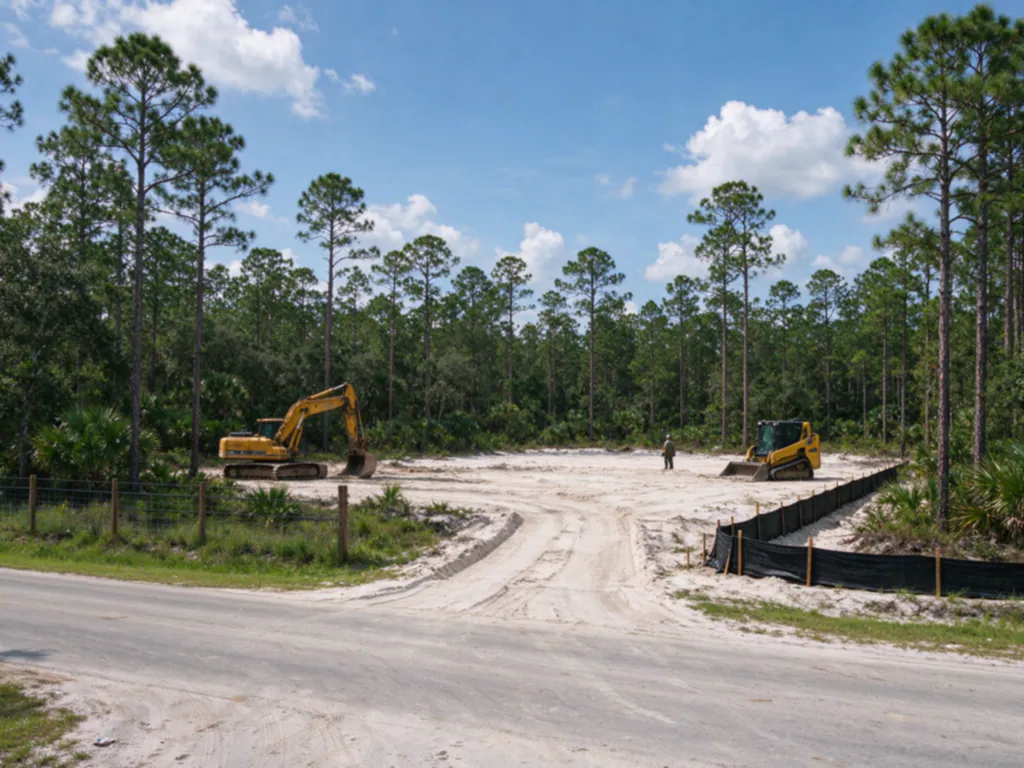 Plate. A Malabar home site, Brevard County
Legend What changes a clearing job in Malabar
Key to the parcel
Malabar's vacant parcels average about an acre and a half, so the question is how much to open. A driveway, pad, septic area and yard can be cleared and grubbed while the back of the parcel keeps its pines.
see Lot clearingThe town maps about 154 acres of sand pine scrub and 25 acres of xeric oak scrub. That is scrub-jay habitat, so the parcel is screened before clearing and the keepers are chosen with care.
see Selective clearingAbout 1,081 acres of the town are wetland habitat. Where a parcel has a delineated wetland, clearing stops at a buffer of at least 25 feet from the line, which can move the house pad.
see Clearing and grubbingWhere a parcel was once grazed, palmetto and brush fill back in. Mulching it back lets grass recover without disturbing the root layer that holds the sand.
see Pasture clearingServices
Residential platted lot
A platted lot opened to the site plan: trees and palmetto out where the house, driveway and septic go, marked keepers protected, and stumps handled to the finish the builder needs.
Pinus elliottii, Sabal palmetto
Unwanted growth out and the keepers flagged and fenced at the root zone the city sizes from trunk diameter, so the trees you save still count on the landscape plan.
Roots and buried organics
Clearing takes what is above ground. Grubbing pulls the stumps, roots and buried organic layer out of the building area so fill and a slab sit on clean sand.
Method: mulching head
Brush, palmetto and small trees shredded where they stand into a mulch layer. Roots and stumps stay in the ground, so it opens land without turning it into a building pad.
Grazing land
Palmetto and invasive brush knocked back on grazing land so grass can recover, with fence lines opened for repair. Whether grazing land needs a clearing permit depends on the town or county.
Understory and vines
Underbrush, vines and saplings cut or mulched to ground level, under the trees you keep, with a straight answer about what grows back and how fast.
Field procedure
The parcel ID or address, what is planned and what should stay. Where the house, drive and septic will sit is asked early.
The parcel is walked to mark the trees to keep and to check for gopher tortoise burrows, wet ground, any wetland line and access from the road.
The scope names the area to be opened, the method for each part, the stump plan, where debris goes and what the town permit has to show.
With permits in hand, keepers are fenced, the work is done, and the finished parcel is walked against the scope, including what soil cover is still needed.
Last Updated:
Flatwood Land Clearing Palm Bay clears home sites, driveways and pasture across Malabar, the small town between Palm Bay and the Indian River Lagoon. The work is carried out by licensed and insured contractors under the Town of Malabar’s own rules, which differ from Palm Bay’s in where the permit comes from, in the wetland buffer and in what has to happen to the soil afterwards.
Malabar is not a grid of quarter-acre lots. Brevard County’s parcel data shows 1,170 single-family homes averaging 1.64 acres and 583 vacant unplatted home parcels averaging 1.45 acres, so a typical job is a parcel where only part of the land needs to be opened. Even the town’s 141 vacant platted lots average 1.43 acres, which puts a platted Malabar lot closer to small acreage than to Palm Bay’s quarter-acre grid. New houses arrive slowly, too: Census permit counts show 28 single-family homes authorized for 2023 and 6 for 2025, so each house site is planned one parcel at a time. That changes the scope. A driveway is often long enough to be its own line item, cleared and grubbed from the road to the house, and the house pad and septic drainfield are opened inside a larger stand that stays. The trees kept along the edges are chosen during the site visit, and selective clearing methods keep machines out of their root zones. On this kind of parcel, clearing the whole acre and a half is rarely the cheapest answer, because it adds stumps, haul-off and replanting without adding usable space. The lot clearing page explains how each area gets its own finish.
Malabar’s comprehensive plan names an adopted Land Clearing and Tree and Landscape Ordinance and directs it to require restoration or mitigation where vegetation is lost. The plan’s Objective 6-1.7 lists the communities it sets out to protect: hardwood hammock, wetlands, prairies and pinelands. So the cost of taking a tree out in Malabar is not only the cutting and hauling, because replacement or mitigation can follow, and how much depends on what the town’s ordinance counts. Those thresholds and fees sit in the town code and are confirmed per address with the Town of Malabar, which handles building permits through its own online portal. The scope can make that application simpler: a sketch of the areas to be opened, the trees to be kept and fenced, and the method for each area. A parcel that opens a driveway and pad and keeps its pine stand gives the town less lost vegetation to mitigate than one cleared edge to edge. Palm Bay’s permit rules are a different system and stop at the town line.
The town’s Conservation Element maps about 2,067 acres of pinelands inside Malabar, plus about 154 acres of sand pine scrub and 25 acres of xeric oak scrub, and the Malabar and Jordan scrub sanctuaries protect some of it. The soils explain the mix. About 65 percent of Malabar’s mapped soil is poorly or very poorly drained flatwoods sand, but the ridge carries excessively drained Paola and St. Lucie sands, the dry white sand where sand pine and scrub oak grow. That dry scrub is the habitat the Florida scrub-jay depends on, and four historical survey polygons on Brevard County’s map reach into the town. Palm Bay’s citywide federal scrub-jay permit covers development inside Palm Bay, not Malabar, so a Malabar parcel in or near scrub is screened on its own before clearing. The scrub-jay guide covers how that check works. Dry scrub ground is also where gopher tortoises dig, and work within 25 feet of a burrow needs a state relocation permit first.
Malabar’s ground is low and mostly flat: a USGS elevation sample in the town reads about 21 feet. What changes from one side of a parcel to the other is the sand. On the ridge, excessively drained Paola and St. Lucie sands drain fast and stay firm after rain, and Paola is mapped at slopes of up to 8 percent, steep by Brevard standards. Off the ridge, poorly drained flatwoods sands hold water near the surface through the wet season. In flatwoods series such as EauGallie and Myakka, federal soil data puts the wet layer about 12 inches down from June to November, and about 55 percent of the 50.79 inches of rain a year at the Melbourne airport falls from June through September. A parcel that straddles both can be workable on its ridge in August while its low side ruts under a tracked machine. Where grubbing or a long driveway runs across the flatwoods side, late winter and spring usually give firmer ground, as the best time to clear land explains, and stump grinding in place of extraction leaves fewer open holes to fill with water.
About 1,081 acres of Malabar are wetland habitat, not counting open water, and roughly a fifth of the town’s mapped soil is rated hydric. Where a parcel holds a wetland, Malabar’s plan requires a buffer of no less than 25 feet measured from the delineation line, so the clearing plan is drawn from the line outward. The line comes from a formal delineation, not from where the ground looks wet in a dry month. Work in or over the wetland itself is a state permit question for the water management district, covered in clearing near wetlands, and it is separate from clearing the upland around it with clearing and grubbing.
Because Malabar parcels run large, the state’s one-acre line matters more here than in Palm Bay. Florida DEP’s construction generic permit covers construction that disturbs one acre or more, and the stormwater pollution prevention plan has to be written before the notice of intent is filed. Clearing a whole 1.5-acre parcel crosses that line; opening the drive, pad and septic area often does not. Debris follows a similar logic. A land clearing pile needs Florida Forest Service authorization and 300 feet from any occupied building, and a square parcel of an acre and a half is only about 255 feet on a side, so piles here are usually chipped, mulched in place or hauled. Whether the town adds its own burning limits is confirmed per address.
Malabar’s comprehensive plan asks for one thing many clearing scopes leave out: soil exposed or destabilized by land clearing and building is to be covered quickly with an acceptable erosion control material. On the town’s sand, a cleared and grubbed pad left bare through a summer storm season washes toward the nearest swale or ditch. So the scope names the cover, whether that is mulch from the job spread over the disturbed edges, seed or sod, or silt fence until the builder takes over, and the erosion control guide explains the options. The full sequence from buying land to a cleared pad is in how to clear a lot to build a house.
Method
Clearing a whole acre-and-a-half parcel costs more, can cross the one-acre stormwater threshold and removes trees the town may ask you to mitigate. Opening the building areas avoids all three.
A buffer measured from a delineated line cannot be judged by eye. Where the parcel may hold wetland, the line sets the clearing limit, not the other way round.
Range
Town of Malabar, under the town's own land clearing and tree ordinance. Which permits a parcel needs, and the fees, are confirmed per address with the town.
Notes
No. Malabar is its own town with its own adopted land clearing and tree and landscape ordinance, which the town's comprehensive plan says must require restoration or mitigation for vegetation loss. Which trees need a permit there, and the fees, are confirmed per address with the Town of Malabar before work starts.
National budgeting ranges run about $1,200 to $2,500 per acre for light growth, $2,500 to $4,500 for moderate and $4,500 to $8,000 for heavy. Dense scrub with grubbing and haul-off can run above that. Opening only the drive, pad and septic area of a larger parcel costs less than clearing all of it.
Brevard County's scrub-jay map shows four historical survey polygons reaching into Malabar, covering about 2,370 acres, with 37 families counted in 1993 and 22 in 2000 to 2002. The surveys are old, so a parcel near sand pine or oak scrub is screened with the U.S. Fish and Wildlife Service process before clearing.
Malabar's comprehensive plan requires a buffer of no less than 25 feet between wetlands and potentially harmful land uses, measured from the wetland delineation line. The actual buffer and what may happen inside it are confirmed per address with the town, and the line itself comes from a formal delineation.
If the clearing and construction disturb one acre or more, Florida DEP's construction generic permit applies, with a stormwater pollution prevention plan written before the notice of intent is filed. Keeping the disturbed area under an acre, where the plan allows, keeps a home site out of it.
Neighboring range
Estimate
Get an estimate for clearing in Malabar
Send the parcel ID or address, where the house, driveway and septic will go, and which part of the land should stay wooded.
(321) 513-1820Outside these hours, emergency calls only.