Last Updated:
Flatwood Land Clearing Palm Bay provides stump grinding in Palm Bay and nearby Brevard towns, from a single pine stump in a front lawn to the dozens left behind when a lot is cleared. Stump grinding in Palm Bay is mostly slash pine, oak and cabbage palm, and the job is the same for each: a spinning cutter wheel takes the stump down below the surface, the roots are left to break down in the sand, and the spot is backfilled for whatever comes next. Grinding is the right finish for lawns, beds and fence lines. Under a house pad or driveway the stump is dug out instead. The work is carried out by licensed and insured contractors.
What happens on the first visit
Each stump gets a quick look for four things. Its diameter, which sets most of the price. Its species, because a fibrous palm base grinds differently from a resinous pine or a dense oak, and a Brazilian pepper stump resprouts unless it is treated. What it sits next to: a fence post, a driveway edge, a pool deck, a kept tree, a septic tank or drainfield. And what the spot will become, which decides how deep the grinder goes and what happens to the chips.
The visit also asks where things run underground. Irrigation lines, a septic tank and its drainfield, and buried electric, cable and water lines can all sit near a yard stump, and a grinder wheel cuts through them in an instant. Utility lines are marked through an 811 locate request before the wheel goes below grade, and private lines such as irrigation and septic are pointed out by the owner. The city’s GIS flags whole Port Malabar units as having no city sewer, so on those lots a septic tank and drainfield are in the yard somewhere and worth finding before grinding near them.
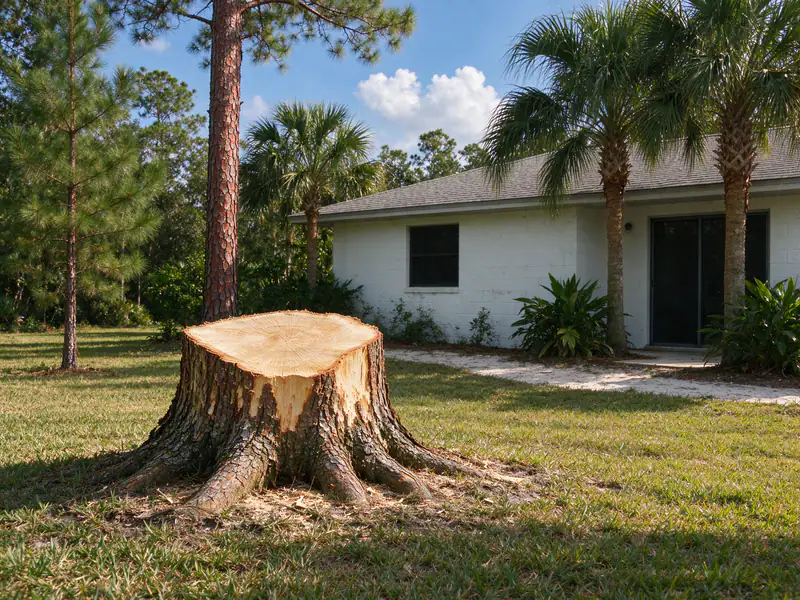
If a stump sits inside the root zone of a tree you are keeping, grinding there damages the kept tree’s roots. On a Palm Bay clearing job the code bars machines from a kept tree’s critical root zone, a circle 12 inches across for every inch of trunk and at least 10 feet, so those stumps are cut flush or left.
How a stump grinder works
A stump grinder carries a heavy steel wheel set with carbide teeth. The operator lowers the spinning wheel onto the edge of the stump and sweeps it side to side, taking off a layer of wood with each pass, then steps the wheel forward and down until the stump is below the surface. Surface roots running out from the stump are followed and ground as well where they would catch a mower.
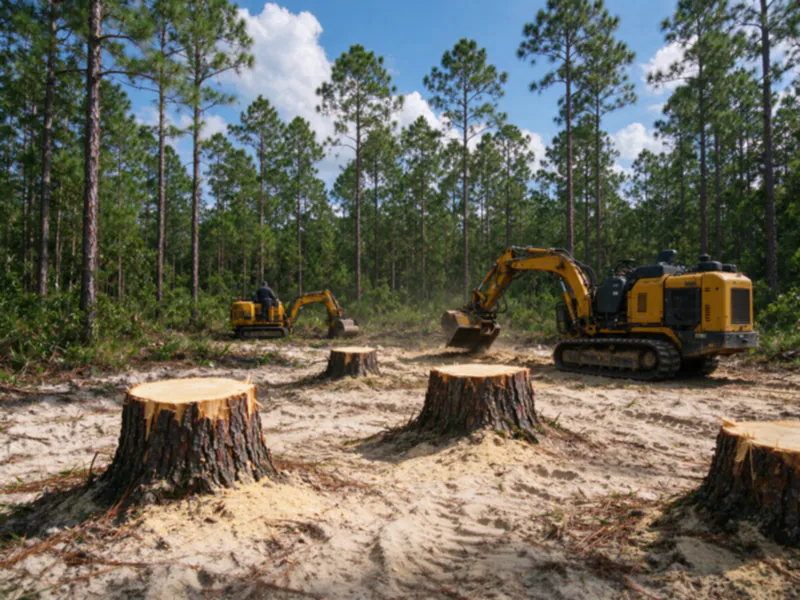
Machines range from walk-behind grinders that fit through a yard gate to tracked and towed units for big stumps and cleared lots. Smaller machines reach backyards without crossing a lawn with a heavy carrier; larger ones grind faster. The scope matches the machine to access and stump size rather than the other way around.
Everyone stays well clear while the wheel runs, because it throws chips and grit with real force, and a stump close to a window, a car or a neighbor’s fence is screened off before grinding.
Grinding or digging out: the choice that matters on a house lot
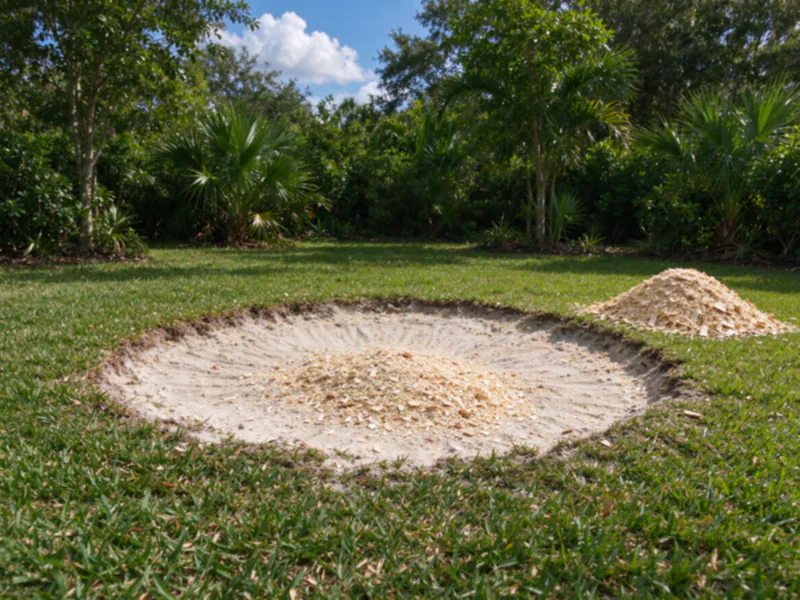
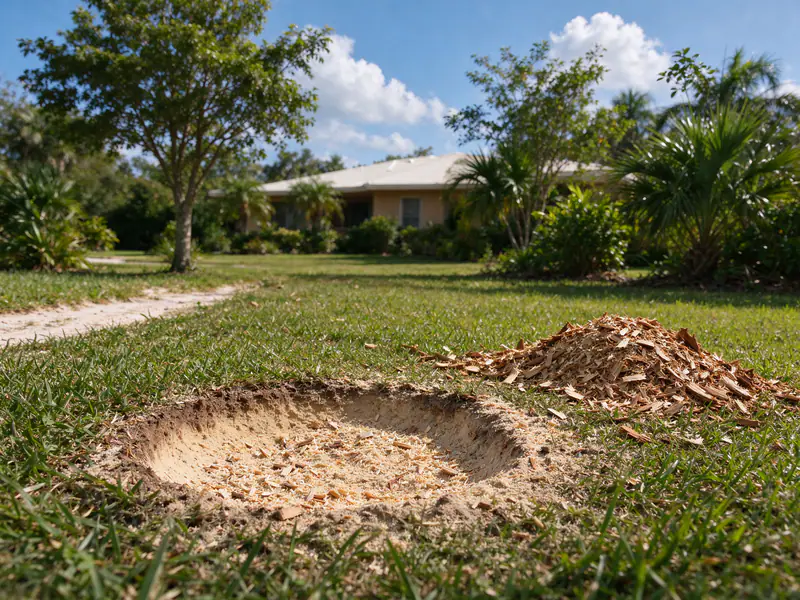
Grinding leaves the base of the stump and its roots in the ground. In a lawn that is fine; they rot slowly in the sand, and the spot may sink a little as they do and need a top-up of sand, one of the follow-ups in the after land clearing guide. Under a slab, a house pad or a driveway, that same slow rot leaves soft spots under the fill, and the structure above can settle. That is why the building areas of a Palm Bay lot are grubbed, with stumps and root balls dug out, and only the yard stumps are ground, as the lot clearing page explains.
Digging out a stump has its own cost. A pine root ball in Palm Bay’s fine sand comes up heavy with sand, leaves a crater that has to be filled and compacted, and adds weight to every load hauled. The stump grinding vs stump removal guide covers the trade-off in more depth, and clearing and grubbing handles the dig-out work.
A yard full of stumps?
Send a count, rough widths and a few phone photos. The scope gives each stump its finish.
Stumps, permits and storm-damaged trees
The tree comes before the stump, and so does the permit. Palm Bay requires a removal permit to cut a tree with a trunk of 6 inches or more at breast height or a palm with 4.5 feet of clear wood, and on a residential lot under an acre any land clearing falls under that permit. Grinding the stump of a tree that is already legally gone is a cleanup of what is left; stumps ground as part of clearing a lot go on that job’s permit. Which applies to a given address is confirmed with the city, and the Palm Bay permit guide covers each permit.
At an existing home, Florida Statute 163.045 lets an owner remove a tree without a local permit when an ISA-certified arborist or a Florida licensed landscape architect documents that it poses an unacceptable risk. After storms, a downed or broken tree can leave a stump ripped half out of the ground, which is grinder work once the trunk is cleared, part of storm debris cleanup.
What stump grinding costs
As national budgeting ranges, stump grinding runs about $120 to $400 for the first stump and $30 to $60 for each additional one. Priced by size, it is about $2 to $6 per inch of diameter, and big jobs are often priced by the hour at about $100 to $200. Service minimums of about $80 to $160 mean a single small stump costs about the same as a slightly bigger one. How diameter is measured, at ground level or across the widest point, differs between quotes, so it is worth asking.
Tree trimmers in the Palm Bay-Melbourne-Titusville metro earn a mean $21.48 an hour against $26.91 nationally, according to the U.S. Bureau of Labor Statistics. A wage is not a billing rate, since the billed rate also carries the machine, fuel, insurance, licensing and overhead, but it shows local labor is not what pushes a quote up. Stump size, count, access through gates, hidden lines and haul-off of the grindings do. The stump grinding cost guide breaks it down, and the cost estimator covers stumps as part of a clearing job.
What a stump grinding scope includes
- A look at each stump: species, diameter, what is next to it and what the spot will become
- Underground utility, irrigation and septic locations marked before grinding
- Stumps ground below grade to a depth that suits the finish, whether lawn, bed or fence line
- Surface roots running from the stump ground out where they would catch a mower
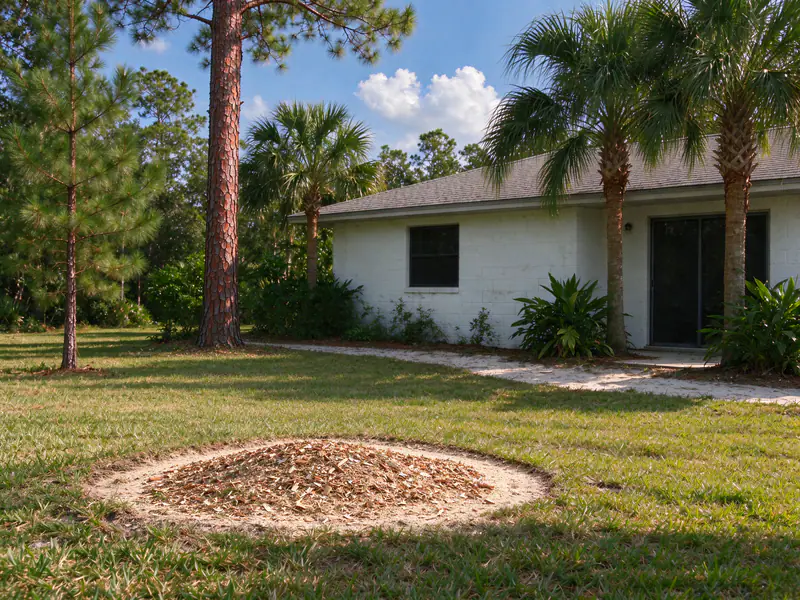
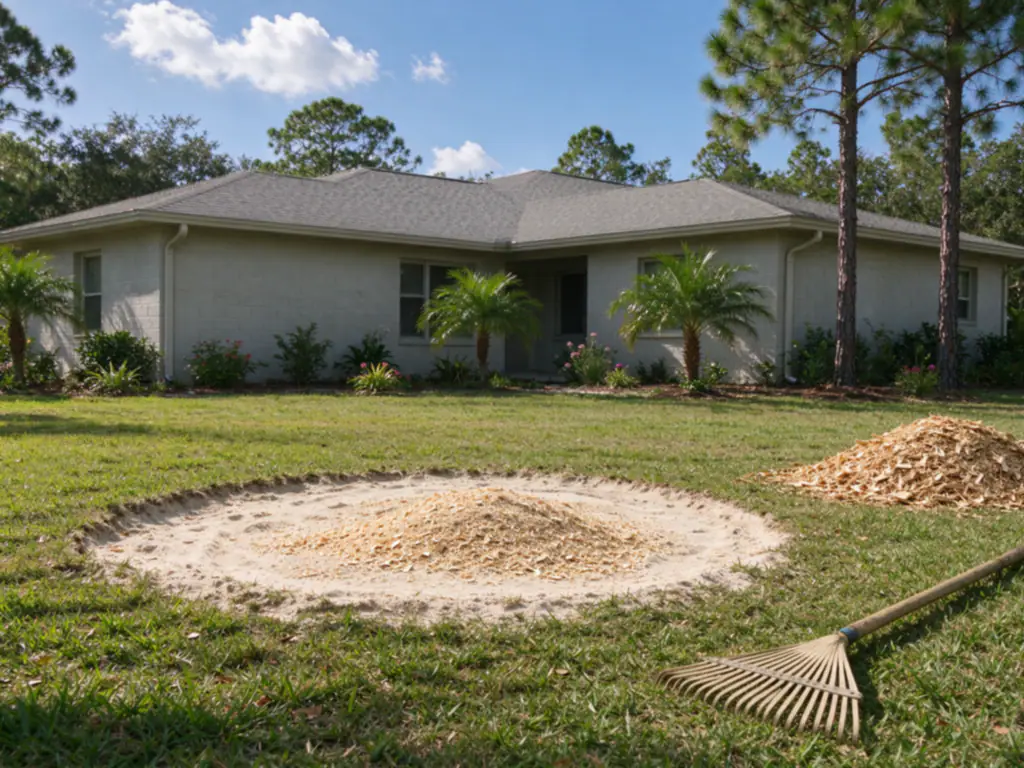
- Grindings left as backfill, raked level, or removed, as the scope sets
- Holes topped with sand where sod or seed goes on next
- A hand-off walk of each stump spot against the scope
Stump grinding or stump removal
| Grind below grade | Dig out the stump and root ball | |
|---|---|---|
| What is left | Roots in the ground, decaying; chips and sand at the surface | A hole to fill and compact; roots removed |
| Disturbance | Small; a spot the size of the stump | Large; a crater and the soil that comes up with the roots |
| Settling later | A slight dip as the stump base and roots rot; topped up with sand | Little if the hole is filled and compacted properly |
| Debris | A pile of grindings | A heavy, sandy root ball to haul |
| Best fit | Lawns, beds, fence lines, yards | House pad, driveway, slab, septic area |
On a house lot, stumps inside the building areas come out with grubbing and the yard stumps are ground.