Residential platted lot
Lot clearing
A platted lot opened to the site plan: trees and palmetto out where the house, driveway and septic go, marked keepers protected, and stumps handled to the finish the builder needs.

Range plate · Grant-Valkaria, Brevard County
Grant-Valkaria is a town of wooded acreage: thousands of unplatted parcels averaging well over an acre, on the largest stretch of historical scrub-jay map in south Brevard. Clearing here is mostly a question of how much of the parcel to open, and what has to be checked first.
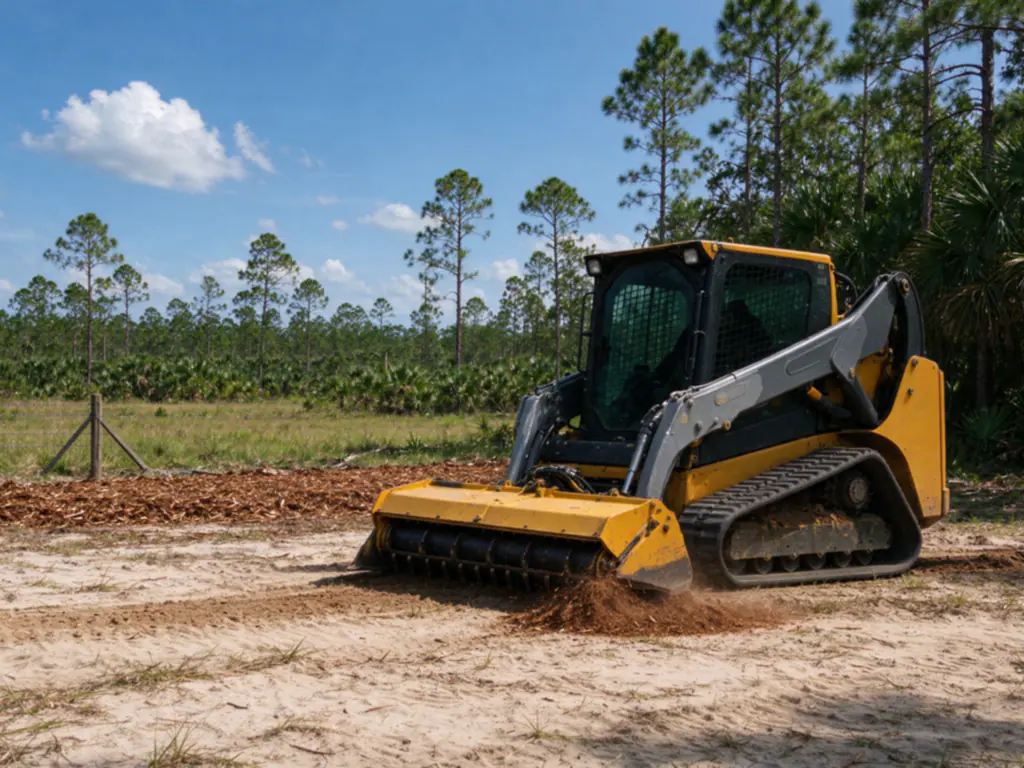 Plate. A Grant-Valkaria home site, Brevard County
Legend What changes a clearing job in Grant-Valkaria
Key to the parcel
Most vacant parcels in town are unplatted acreage. The driveway, house pad, septic area and yard are opened and grubbed, and the rest of the stand can stay as it is.
see Lot clearingWhere grazing ground has filled with saw palmetto and brush, a mulching head knocks it back to grass level without stripping the sand bare.
see Pasture clearingTrails, fence lines and sight lines through the trees can be opened by forestry mulching, which leaves roots in place to hold the soil.
see Forestry mulchingDry scrub inside the town's mapped scrub-jay polygons is screened before anything is cut, and the trees to keep are chosen with the habitat in mind.
see Selective clearingServices
Residential platted lot
A platted lot opened to the site plan: trees and palmetto out where the house, driveway and septic go, marked keepers protected, and stumps handled to the finish the builder needs.
Method: mulching head
Brush, palmetto and small trees shredded where they stand into a mulch layer. Roots and stumps stay in the ground, so it opens land without turning it into a building pad.
Grazing land
Palmetto and invasive brush knocked back on grazing land so grass can recover, with fence lines opened for repair. Whether grazing land needs a clearing permit depends on the town or county.
Pinus elliottii, Sabal palmetto
Unwanted growth out and the keepers flagged and fenced at the root zone the city sizes from trunk diameter, so the trees you save still count on the landscape plan.
Roots and buried organics
Clearing takes what is above ground. Grubbing pulls the stumps, roots and buried organic layer out of the building area so fill and a slab sit on clean sand.
Logs, slash and stumps
Clearing debris chipped and spread, mulched in place, or loaded and hauled to a permitted site. Which one fits depends on the finish and on whether burning is allowed at all.
Field procedure
The parcel ID or address, what the land is for and which part should stay wooded. Acreage jobs start with a rough map of what to open.
The parcel is walked to mark keepers, look for gopher tortoise burrows and wet ground, note any scrub, and check how machines get in from the road.
The scope maps each area and its method, the stump plan, where debris goes, and which town, state or federal checks come before work.
With the checks cleared, keepers are fenced and the work is done; the hand-off walk compares the finished parcel with the scope.
Last Updated:
Grant-Valkaria went from 20 new single-family home permits for 2020 to 304 for 2023, and the land those houses go on is mostly wooded acreage rather than a platted grid. On that kind of land, Flatwood Land Clearing Palm Bay scopes and manages home site, pasture and back-acreage clearing across Grant-Valkaria, and licensed and insured contractors do the work. The town’s mix of acre-plus parcels, flatwoods sand and old scrub-jay territory makes the scope a matter of choosing what to open, not just what to remove.
Brevard County’s parcel data counts 2,657 vacant unplatted single-family parcels in Grant-Valkaria, averaging 1.38 acres and adding up to about 3,677 acres, plus 488 vacant platted lots that average 0.93 acres. The 2,557 homes already built average 1.45 acres. The Census Bureau’s estimates put the population near 5,982, up about a third from the 2020 count of 4,508. So a typical clearing call here is a buyer standing on a wooded acre and a half, deciding where the house goes and how much of the stand to keep. The answer shapes the bill more than anything else. Opening a driveway, a house pad and a septic area with clearing and grubbing leaves most of the parcel standing, while a full clear multiplies the stumps and the haul-off. The lot clearing page lays out how each area of a home site gets its own finish.
Eight historical scrub-jay survey polygons on Brevard County’s map reach into Grant-Valkaria, covering about 7,972 acres between them. That is more mapped historical habitat than Palm Bay, Malabar or Melbourne shows. The surveys counted 108 scrub-jay families in 1993 and 53 in 2000 to 2002, so the map records where the birds were, not where they are now. It still decides the order of work. A parcel in or near one of those polygons, especially one with sand pine, scrub oak or bare white sand, is screened for scrub-jay use under the federal process before any trees come down, and the scrub-jay guide explains what that check involves. The same dry ground suits gopher tortoises, and Florida’s wildlife commission requires a relocation permit before any work within 25 feet of a burrow, which is why burrows are looked for on the site visit. The gopher tortoise survey guide covers what happens when one turns up.
Federal soil data rates about three quarters of the town’s mapped soil as poorly or very poorly drained, and about a third as hydric. The common series are Myakka, EauGallie, Pomello and Basinger sands. Pomello is rated somewhat poorly drained, while the flatwoods series hold the water table close to the surface in the wet months. Only about 4 percent of the town is well drained. The land is also low, with a USGS elevation sample of about 22 feet. For a clearing job that means two things. Tracked machines, and work planned for the drier months, keep a parcel from rutting when the ground is soft. And a hydric map unit is a flag, not a finding: a low spot that holds water after rain may be a wetland, and that is settled before the scope is drawn, as clearing near wetlands explains.
Acreage is where pile burning starts to be possible, and it is still rarely the simple answer. Florida Forest Service rules require authorization for a land clearing pile and place it at least 300 feet from any occupied building, 50 feet from brush and other wildland fuel, and 100 feet from a paved public road. On a 1.38-acre parcel, about 245 feet on a side, there is nowhere a pile can sit that far from the neighbors. On a five- or ten-acre tract, with distance to spare, an authorized burn may fit, unless a drought-index burn ban is in effect. For most jobs the choices are forestry mulching in place, chipping and spreading, or loading the logs and stumps for debris hauling. The guide to burning land clearing debris covers when a burn is allowed.
The town sets its own clearing and tree requirements, and they are confirmed per property with the Town of Grant-Valkaria before work starts. A parcel across the county line to the south falls under a different rulebook, which the page on land clearing in Sebastian covers. Two state lines apply no matter what the town asks. Florida DEP’s construction generic permit covers construction that disturbs one acre or more, with a stormwater pollution prevention plan written before the notice of intent is filed, so a house site that opens most of a 1.38-acre parcel can cross it while one that opens the drive, pad and septic area may not. And the water management district’s environmental resource permit is required for work in wetlands or for a project over five acres. Mulching the back acreage of a pasture clearing job is lighter on the ground than grubbing, and the mulching versus clearing guide compares the two.
Method
A drive, pad and septic area cleared inside a standing stand cost less than a full clear, keep the disturbed area smaller and leave the rest of the trees working as shade and windbreak.
With the county's largest historical scrub-jay polygons in town, the habitat question goes first. It can change which trees stay and when the work can start.
Range
Town of Grant-Valkaria. The town's own clearing and tree permit requirements, and any fees, are confirmed per property with the town before work starts.
Notes
Grant-Valkaria is its own town, outside Palm Bay's tree code and outside the county's unincorporated rules, so its own clearing and tree requirements apply. What a parcel needs, and any fee, is confirmed per property with the Town of Grant-Valkaria. State and federal checks, such as gopher tortoise burrows and scrub-jay habitat, apply either way.
National budgeting ranges put forestry mulching at about $400 to $800 per acre for typical growth and up to about $2,000 per acre for dense palmetto and brush. Hourly work runs about $125 to $300 per machine hour with an operator, and small jobs often carry a $400 to $600 minimum. A site visit sets where a parcel falls.
Brevard County's scrub-jay map shows eight historical survey polygons reaching into the town, covering about 7,972 acres, with 108 families counted in 1993 and 53 in 2000 to 2002. That is the largest mapped area of any south Brevard town. The surveys are old, so a parcel in or near scrub is screened before clearing.
Only with Florida Forest Service authorization, and only where the pile can sit at least 300 feet from every occupied building, 50 feet from brush and 100 feet from a paved road. A square parcel of 1.38 acres is only about 245 feet on a side, so most home sites chip, mulch or haul instead. Drought-index burn bans also close the option in dry spells.
Under Florida's environmental resource permit rule, work in, on or over a wetland needs one, and so does a project with a total area over five acres or one that is part of a larger plan of development. Clearing upland on a single home parcel usually falls under neither, but a wet low spot is checked before the scope is drawn.
Neighboring range
Estimate
Get an estimate for clearing in Grant-Valkaria
Send the parcel ID or address, how much of the land you want opened, and where the house, drive or pasture should go.
(321) 513-1820Outside these hours, emergency calls only.