Last Updated:
Flatwood Land Clearing Palm Bay provides clearing and grubbing across Palm Bay and south Brevard, from single house pads in Port Malabar to building footprints on commercial and acreage sites. The two words name two different jobs. Clearing takes off what stands above the ground: trees, brush, palmetto fronds and vines. Grubbing takes out what is in the ground: stumps, root balls, the horizontal trunks of saw palmetto and the dark organic layer at the surface. Anywhere fill, a slab, a driveway base or a parking lot will go, the second job is the one that matters. The work is carried out by licensed and insured contractors, from a written scope that marks which areas are grubbed and which are only cleared.
What happens on the first visit
The first visit draws the grubbing limits. On a house lot that usually means the pad, the driveway corridor and a working margin around both; on a commercial site it means the building and paving footprint from the approved site plan. Everything outside those lines may only need clearing, stump grinding or nothing at all, and every square foot left ungrubbed is cheaper and keeps more of the lot stable.
The walk also counts and sizes the stumps, because stump and root volume drives both the machine time and the debris load. It looks for gopher tortoise burrows, since pulling stumps within 25 feet of one needs an FWC permit first. It checks for wet ground and standing water, for buried utility lines near the street where a stump will be dug, and for a canal easement along the back line, where the work has to stop at the easement edge. Trees you want to keep are flagged so they can be barricaded before anything is dug.
Why roots under a building area have to come out
Wood buried under fill does not stay put. Stumps and roots decay over the years, and as they do they leave voids that the sand above slowly drops into. Under a lawn that shows up as a dip. Under a slab, a driveway or an asphalt lot it shows up as cracking and settlement, which is why building and road specifications start with grubbing rather than with fill.
Saw palmetto adds a second reason. Its trunks creep along and just under the sand and keep resprouting from wherever they are left, so a pad that was only mowed or mulched grows palmetto back through the edges of the fill. In the structural areas those trunks are dug and raked out; at the edges they can be cut back, which the saw palmetto clearing page covers in more detail.
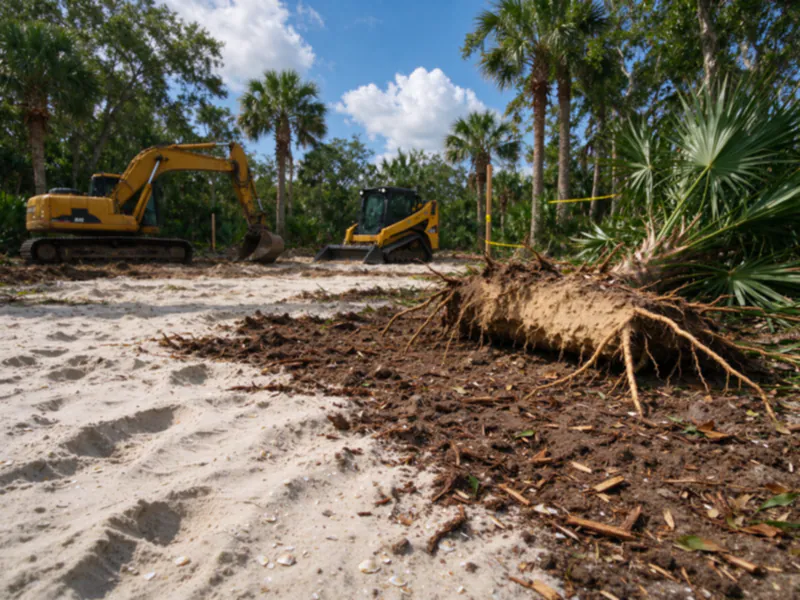
The holes are the third thing to plan for. Every pulled stump leaves a pit and every lateral root leaves a channel, so a freshly grubbed site is uneven ground. The holes are backfilled and tracked down so the site is safe to walk and work, but that is rough leveling, not grading. Fill, finish grade and compaction to a building standard are the next trade’s work, and the scope says where clearing ends so that trade starts on a known surface.
How the work is done: excavator, root rake and topsoil
The trees and brush come off first, the way they would on any lot clearing job, with mature trees felled into a planned drop zone and everyone kept clear of the drop zone and the machines. Then the ground work starts.
Pulling stumps with an excavator
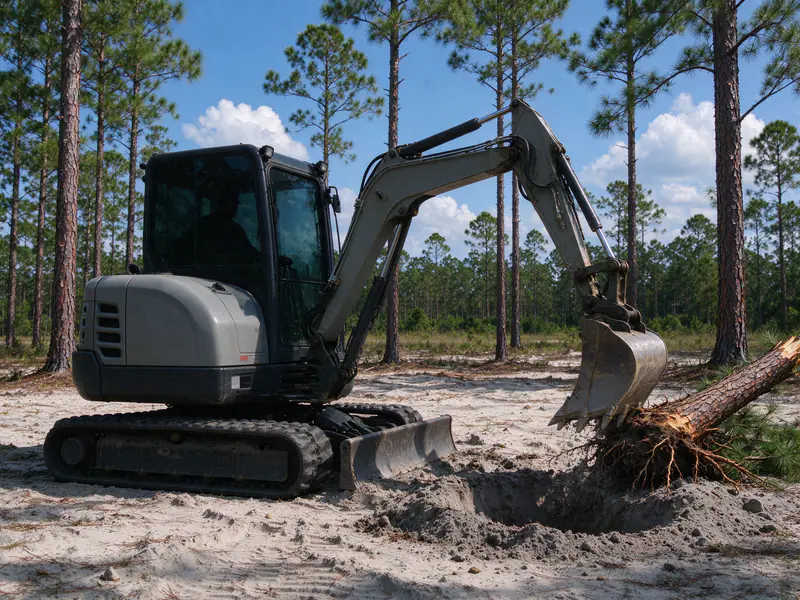
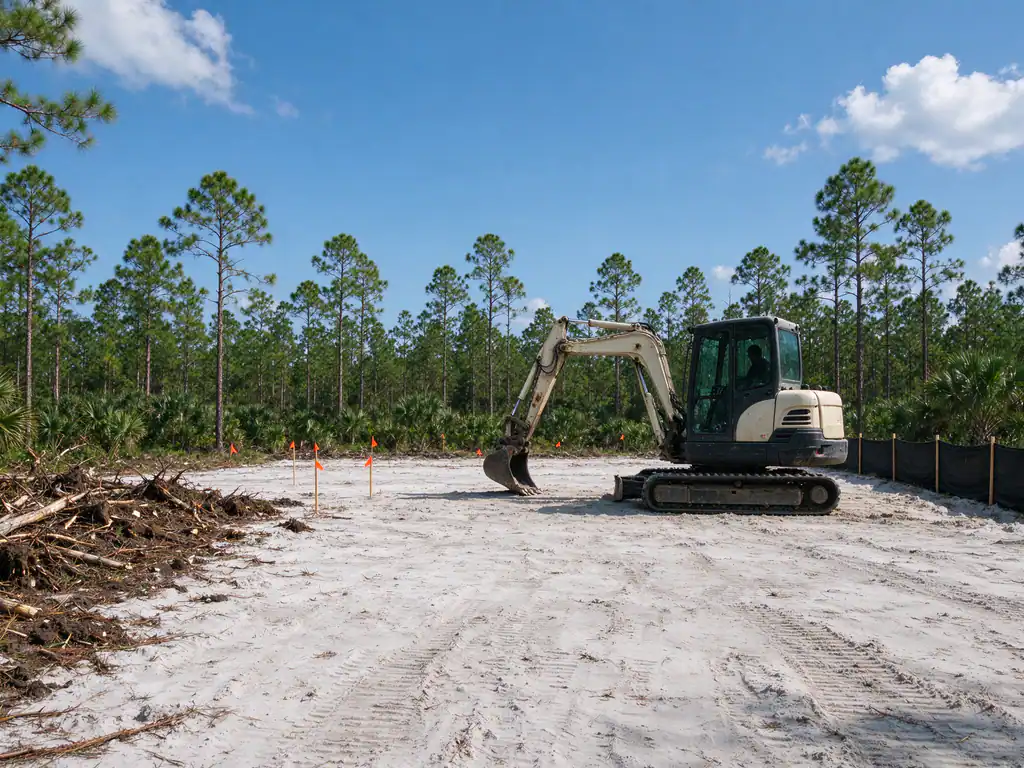
An excavator with a thumb pries each stump out, root ball and all, and shakes it to drop as much sand as possible back into the hole. That shaking matters more than it looks. A stump that comes out caked in sand weighs more on the truck, dulls chipper and grinder teeth, and is harder to dispose of, so clean stumps are cheaper stumps.
Root raking the surface
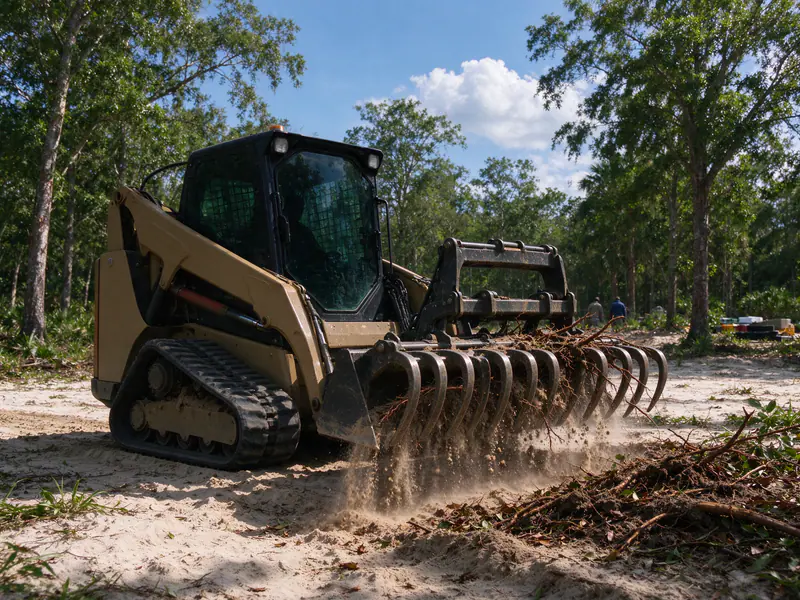
Once the big stumps are out, a root rake on a loader or dozer combs through the top of the sand. Its long tines catch palmetto trunks, small roots and buried limbs and drag them into windrows for loading, while the sand falls through. Passes in more than one direction leave the structural area clean enough for the next trade to judge.
Stripping and keeping the topsoil
The dark surface layer on flatwoods sand is mostly organic matter, which is the wrong material under fill but useful in a yard. Where the site plan allows, it is stripped from the structural areas and stockpiled at the edge of the lot for the lawn and planting beds later; where it does not, it is hauled. The scope says which, because a stockpile takes space on a quarter-acre lot and hauling it adds loads.
Working with Palm Bay’s water table
Most of Palm Bay sits on poorly drained sand. In EauGallie sand, the most common soil in the city, the wet layer rises to about 12 inches below the surface from June through November and drops to about four feet by April and May, per the USDA soil survey. In the wet months a stump hole can fill with water as soon as it is dug, which makes backfill sloppy and leaves soft spots, and tracked machines rut the pad. The dry spring is the easiest grubbing window of the year, as the best time to clear land guide explains.
Not sure how much of the site needs grubbing?
Send the site plan or a sketch of the house, driveway and septic, plus a few phone photos. The grubbing limits come from there.
Palm Bay’s “grubbing permit” is not what the trade calls grubbing
This is the local detail that trips people up. Palm Bay’s Chapter 175 tree code uses the word grubbing for underbrush removal. Under §175.015 a grubbing permit covers underbrush taken out by hand clearing, roto-chopping or mulching in place, and it expressly does not authorize clearing, scraping, balancing or filling land, or removing protected or specimen trees. It is not needed at all on one- and two-family residential sites under an acre, or where the area being worked is a quarter acre or less.
Pulling stumps and scraping the ground for construction runs through a different permit:
- On a one- or two-family lot under an acre, it is part of the Tree Removal and Small Residential Site Land Clearing Permit under §175.014, which needs the building permit already under review and a site sketch showing every tree’s species and trunk diameter.
- On larger residential sites and on multifamily, commercial, industrial and institutional sites, it needs a Site Work Permit under §175.016, which requires an approved site plan, a tree survey and an environmental assessment. The commercial land clearing page walks through that permit.
Fees for each permit are set per the city’s current fee schedule. Grubbing without the right permit carries a double fee on the late application, and where a restoration plan is not feasible the code charges the specimen tree mitigation fee for every quarter acre grubbed. The Palm Bay permit guide covers the paperwork.
Outside the city the rules change. Unincorporated Brevard’s small-scale land clearing permit allows up to half of a site’s understory or one acre, whichever is less, so a whole-site grub of a vacant county parcel is not a small-scale job. Melbourne treats underbrush clearing as its own permitted activity, as the Melbourne page explains. Anywhere near a wetland, the state’s rules come first; see clearing near wetlands.
Where the stumps and roots go
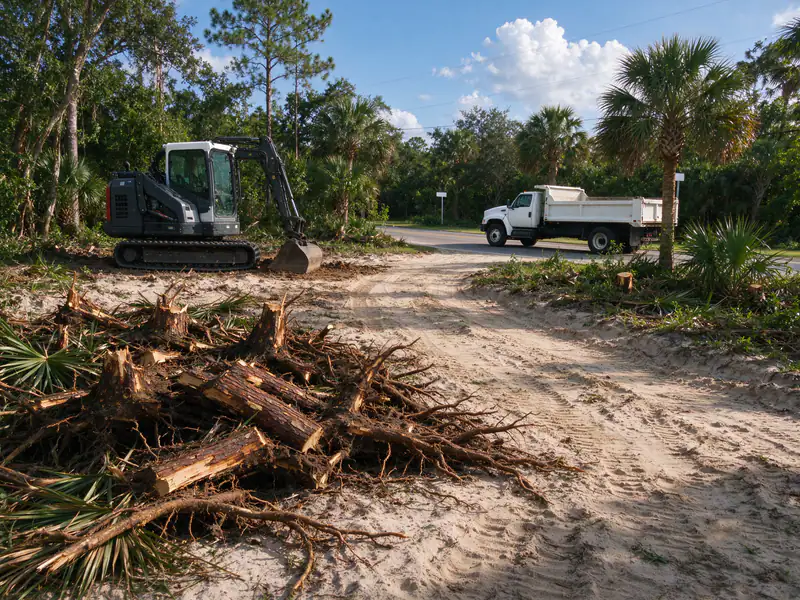
Grubbed material is the hardest debris on a clearing job: heavy, mixed with sand and too dense to mulch in place. Clean stumps can be ground on site; the rest is loaded and hauled to a facility that accepts land clearing debris, per the county’s posted gate rates. Burning is rarely an option on a Palm Bay lot, because Florida Forest Service rules keep land clearing piles at least 300 feet from any occupied building. The options and their trade-offs are on the debris hauling page and in burning land clearing debris.
Bare grubbed sand is also the most erodible ground on any site, especially in the June to September rains. Erosion control after land clearing covers what keeps it on the lot until the next trade arrives, and clearing vs grubbing sets out the decision in one place.
What a clearing and grubbing scope includes
- A walk of the site to mark the grubbing limits, kept trees, burrows, wet ground and buried utilities
- A written scope that says which areas are grubbed, which are only cleared and where the material goes
- Root zone barricades around kept trees before any machine work
- Trees and brush cleared from the grubbing area first
- Stumps and root balls pulled and shaken free of sand
- Root raking of the structural areas to comb out palmetto trunks and lateral roots
- The organic surface layer stripped from structural areas and stockpiled or hauled, as the site plan says
- Stump holes backfilled and tracked down to a rough, walkable surface
- A hand-off walk with the grubbing limits shown to the next trade
Three finishes for the same wooded ground
| Cleared only | Cleared and grubbed | Forestry mulched | |
|---|---|---|---|
| What is left in the ground | Stumps cut low and every root | Clean sand with stumps, roots and organics removed | Stumps at or near grade and every root, under a mulch layer |
| Fit for fill, slab or road base | No | Yes, once the next trade compacts it | No |
| Regrowth | Palmetto and hardwood sprouts return from what is left | Little in the grubbed area | Palmetto resprouts from trunks left in the sand |
| Debris volume | Wood only | Wood plus stumps carrying sand | Most material stays on site as mulch |
| Typical use | Yard areas that will be stump ground and sodded | House pads, driveways, parking and building footprints | Lots being held, trails, firebreaks and edges |
Most sites mix all three: grubbed where something will be built, cleared where lawn goes, mulched or left at the edges.